A fresh wind blows down the Bosporous Strait from the north as I explore the waterfront of the divided city of Istanbul.
The port is bustling. Riverboats, fishing boats, ferries and international shipping criss cross each other sounding warning horns at frequent intervals. The shore workers are loading or unloading as stray cats pay close attention, surveying the boats for a likely source of their next helping of fish offcuts.
Istanbul is a city divided in two by the Bosporous Strait, a narrow strip of water that connects the Black Sea to the north with the Sea of Marmara to the south, which connects to the Aegean Sea via the Dardanelles Strait, otherwise known as the Strait of Gallipoli and out to the Mediterranean Sea. These waters are important for trade and cultural links. The Black Sea contains Russia’s only warm water port. Blocking the Strait of Gallipoli during World War I was a strategic military objective, that ultimately failed, of the British, Australian and New Zealand armies.
The strategic importance of the location now occupied by the city of Istanbul was the key to its founding. Constantin, Roman Emperor in the early 4th century founded the city and it was duly named Constantinapolis, although that mouthful became Constantinople. Later, it was called Byzantium, as the central important city of the eastern, or Byzantine, Roman Empire. The Byzantine empire survived the fall of the western Roman empire and remained the ruling authority until the 15th century when it succumbed to the Ottoman Empire.
My observations are interrupted by a local trader. The traders here are enthusiastic and they apply pressure firmly to the passing tourist, but with grace and charm. I can not remember being subject to such sales pressure before, anywhere. I am invited to enjoy his family’s hospitality and while my protestations are duly noted, they are subsequently ignored and soon I am inside drinking Turkish coffee and all the while being invited to admire the intricate pattern and storyline of this exquisite rug that, I’m told, may take up to a year to weave by hand. I am in a battle of wills and my main aim is to escape with a scoreless draw.
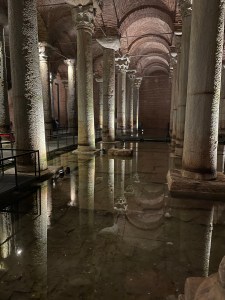
The Bosporous divides Istanbul into the western, or European, side and the Asian side. Constantin founded the city on the western side. The city was fortified by walls, many parts of which are still standing and obvious. The Romans also built water infrastructure, lengthy aqueducts to carry water hundreds of kilometres from inland sources to the growing city. Since these aqueducts were vulnerable to attack by marauding forces, underground reservoirs, or cisterns, were built inside the walled city to store massive volumes of freshwater that would allow the city to survive sieges. Existing caves were excavated into underground caverns, immense pillars holding up the land above. Many of those cisterns remain, including the most famous, the Basilica Cistern. Today the cistern is a tourist attraction.
The sign behind the desk of my hotel says the hotel is at the highest point of Sultanahmet, the local district, including the Hippodrome of Constantinople. As I struggle back up the hill to my hotel, I wonder why the Romans loved to build aqueducts but couldn’t be bothered grading the roads. The streets of old Istanbul, within the walls, are an intricate mesh of narrow steep cobbled and seemingly random design. The few lanes that are straight for any length seem to be the ones that go straight up the hill, at a gradient I would estimate to exceed 25%. Excruciating. Still, I can view the ancient Hagia Sophia mosque from an elevated vantage point. The mosque was built in the 6th century to be a Christian cathedral. With the Ottoman Empire conquest of Constantinople the cathedral was converted to an Islamic mosque and the minarets were added.
I’m interrupted while pausing for breath. An enthusiastic trader spotted me and wants to share Turkish hospitality and at the same time sell a rug. I’m not in the mood.
The city is home to around 18m people. The country of Turkey is home to around 85m people. Inflation is rampant. The Lira lost over 80% of its value last year. The current annual inflation rate has dropped to around 45%. For a country with a negative trade balance, inflation is especially serious. The local traders, once the sales battle is over, discuss the state of economic affairs with an air of gloom.
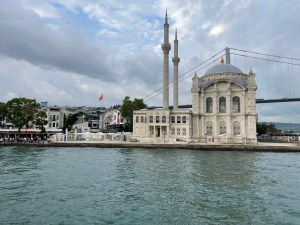
A boat tour of a section of the Bosporous Strait opens up views to not only ancient fortifications, but conspicuous wealth in the form of waterside mansions. Some date back over 100 years. Many are newer and more modest in architecture and building yet attract prices of tens of millions of US dollars. The tidal range is small and so the mansions are built right on the water side. Many have a small private jetty used to secure a boat.
The signs of big business are evident away from the historic old city. The airport, the open cut mines, the electricity transmission lines are all of a massive scale. Turkey’s top value exports are in vehicles and trucks, heavy manufacturing and refined oil products. The past is clinging on, reluctant to let go of the old world that remains on display in Sultanahmet. Yet even here, a transition is on display. At the street stalls where men, never women, prepare and sell their wares, dressed in traditional Turkish style, smart phones are pulled out in the quieter moments. A smartphone video calling street-vendor in the ancient city of Istanbul, within earshot of the Hagia Sophia mosque, is surely a sign of economic progress.
Trading is a way of life. The shop-owners remain at or near their shops all day. They interact with each other, shouting greetings at passing acquaintances, observing everything, missing nothing and haggling all the while with passers by. It is a means to earning a living, entertainment and socialising all bound together.
As I make to leave the city, I am watched by a languid cat whose tail is gently flicking in the heat. He accurately assesses I am of no interest to him and turns in search of better prospects.
 Australian Actuary