Mt Vesuvius stands like a guide post to incoming ships. The captain of a cruise ship orders the course just north of the Isle of Capri and then a heading straight at Mt Vesuvius. Soon the ship is secured at a Naples harbour pier, so close to the street that I can almost touch the bow.
I had noticed the ship on its approach while enjoying a leisurely breakfast at my waterfront hotel. The bay of Naples was calm, a number of luxury yachts were at anchor and a boatman was attending to his nets and pots just off Castel dell’Ovo. Fresh seafood pulled from the sea in the morning and on tourists’ plates in the evening, cooked and presented according to ancient custom. Soon enough, day trippers from the cruise ship arrive on exploration.
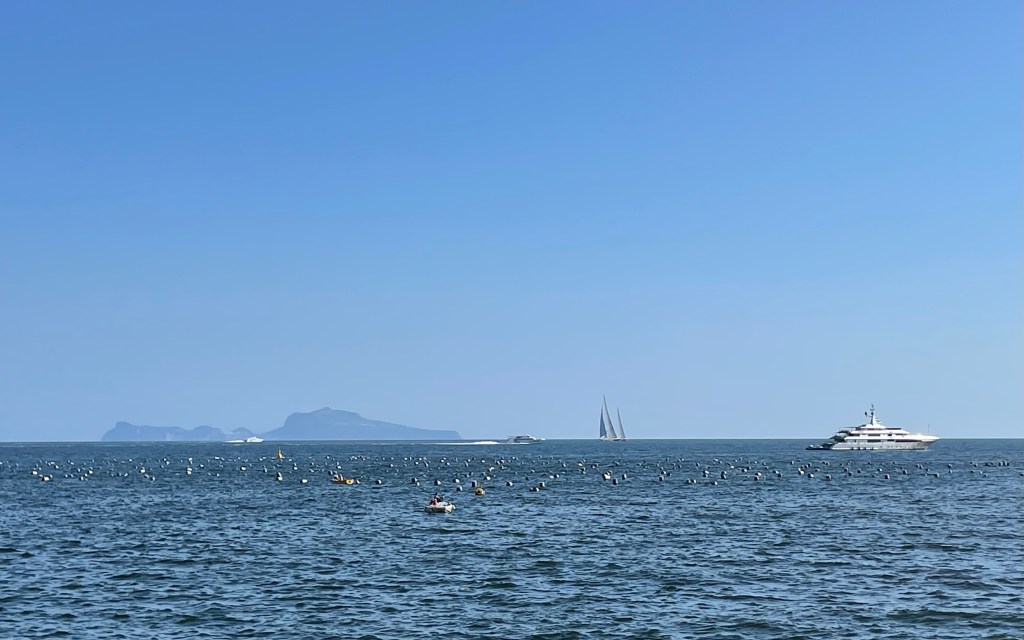
Naples is among the world’s oldest continuously inhabited urban sites. And yet it nearly wasn’t. Nearby Pompeii and Herculaneum could have been, had Mt Vesuvius not obliterated them in AD79. When the volcano erupted, its lava destruction flowed east and south. Naples is south west of the mountain. Naples was spared. It must have been one heck of a view.
The city clings to the side of a hill and spills downward to the sea, mimicking a lava flow. The waterfront is a mixture of dilapidated grand buildings and glorious wooden superyachts. Of unkempt botanic gardens and middle age grand sculptures. Of wide boulevards and statues of Roman statesmen. Of tourists and corporate conferences. Of times gone by. Of decay. Of heat. Of death.
Only one or two streets back Naples is dirty, hot, crowded and noisy. “Bongiorno,” I offer as I walk by. The man had been staring into the middle distance in his white tee shirt. He hears me and responds with a broad smile and “Bongiorno!” He is watching the world from his front door and I am but a visitor, a tourist, an alien. People react to each other the same way all over the world, if allowed to.
The heat rises. The insects buzz ever more angry. The US consulate building stands on the foreshore guarded by a number of Italian police and a pride flag. I can’t tell which is more effective. Nobody appears to care.
I am interrupted as I ponder images in my mind’s eye of Grace Kelly, Cary Grant, David Niven and others of the Hollywood set of the 1950s depicted in films shot in Naples. Police are in attendance outside my hotel, braces of guns in their belts, shoving curious bystanders back and preparing space for buses. Dignitaries are being readied to exit my hotel and in to the buses. Local politicians I expect. Or EU delegates. Who knows, who cares.
The journey from Basilicata to Naples is a speedy one via one of Italy’s Autostrada motorways. Hannibal would have been grateful for an Autostrada in his day. It makes short work of the mountainous terrain. The journey from Naples waterfront to Naples airport is different. Leave plenty of time and keep patience in supply is my suggestion.
 Australian Actuary