It’s not about the virus

I can’t imagine that there is anybody left, anywhere in the world, who still believes zero COVID by lockdown, mass testing, contact tracing and so forth is possible.

Consequently, this latest action from the Chinese Communist Party cannot have anything to do with a pandemic response. It’s not about the virus. It’s much more likely to be about maintaining power and crushing dissent. The virus is just the excuse.
How multiple decrements and standard deviations affect Australia’s senior citizens

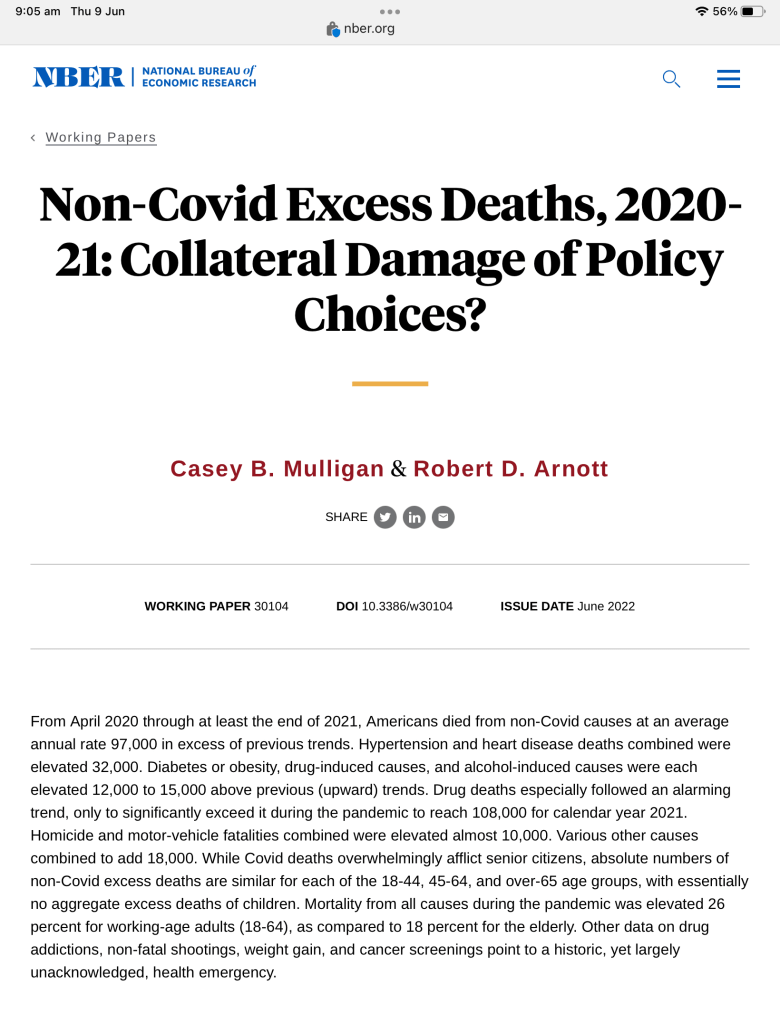
The ABS most recent publication on Australian mortality experience was released towards the end of May, with the rather noteworthy key point that for the first two months of 2022, all cause mortality is up over 20% compared to normal, Figure 1.

When it comes to vital statistics of mortality, departures of this magnitude are rare, indeed. This represents about two standard deviations (more on that below) over the baseline, which was measured over the seven calendar years to 2021 inclusive. So, I obtained the full set of data from the ABS website to review the results in more detail, given the data are broken down by state, age group, cause of death and by both sexes.

Figure 1. (Source: Australian Bureau of Statistics )
Continue reading →

20% increase in mortality?

I haven’t yet read the report properly. No doubt many statisticians, demographers and actuaries will be doing so now. It feels to my old actuarial bones that a 20% increase in mortality, relative to trend, is notable. That’s a big deviation. Worth reading in full.

Trouble brewing in Europe

Germany is the largest economy in Europe. Things are not going well there. It is less than four years ago that President Trump spoke at the UN and was openly laughed at by the German delegation. Trump’s laughable comments, as perceived by the Germans, were to warn of impending serious problems since Germany had deliberately wound back its power generation capacity in favour of long term access to Russian gas.

Now look what two stories appear on the same page of the FT:

Continue reading →

Investment in an inflationary environment

Investing in an inflationary environment is new to me in practical, but not theoretical, terms. It has been obvious for over a year now that this current inflation was emerging. But it hasn’t made the practical decisions of how to invest any easier. The last time the world’s major economies experienced significant inflation was at the end of the 1980s. I didn’t have any money to invest back then, so my understanding was theoretical, not practical. I read about it. Fast forward 30 years, I’m now living on the success or otherwise of my investment decisions in what is turning out to be an inflationary environment. At the beginning of 2021, I made my views clear in public professional circles that inflation was emerging as a looming threat. Many didn’t believe me. But we all have to deal with it now.

So, how to invest?

Continue reading →

Increase university places at no extra cost?

Did anyone see the report the other day that a study by the Centre for Independent Studies found that university places in Australia could be increased by 80,000 at no extra cost? What? How is that possible? It turns out that the cost savings could be made by removing doubling up in taxpayer supported placements. Double degrees etc. Now, ask yourself this: would removing doubling up in taxpayer support to create savings such that 80,000 extra students could enter university be a good thing?

Continue reading →