Economists, groupthink and dark clouds

The official cash interest rate in Australia is 2.5%pa. According to business press surveys of “leading economists”, most believe that the Reserve Bank of Australia should cut the official rate very shortly. Weak economic growth and rising unemployment worry the economists and their policy response recommendation is to reduce interest rates. We shall find out soon enough if the RBA takes that approach, but if the business press is correct, what is it about these economists that makes them unable to see that if interest rates are already at low levels and economic growth is insipid, then the problem is not likely to be a high interest rate. Can’t they see what happens in other countries where official interest rates have approached zero and it has not spurred economic activity?

So-called leading economists who argue that more artificial credit expansion, in an environment that has already suffered more artificial credit than is reasonable, are firstly demonstrating that they have no clue as to what has caused the mess nor how to get out of it. Secondly, they cling to each other and reinforce their collective group-think views because they have little else to comfort themselves that they know what is going on. This fear on their part and their response to argue for more policy medicine along the same lines that is making the patient sick is leading to ever increasing dark storm clouds looming on the economic horizon.
Continue reading

Longevity – is it a new incurable disease?

If you care to look at the financial press, personal investment magazines or the information brochures published by superannuation funds, you could be excused for concluding that a new incurable disease has become entrenched in the community – longevity. The fear of living too long and running out of money in retirement is affecting more and more people, particularly in the light of weakening Government finances which are needed to pay for the age pension.

Enormous volumes of papers and investment brochures, armies of financial advisors, whizz-bang calculators and projectors available on-line are all at work on the population. The message is almost always that Australians need to save more for retirement. People are constantly reminded of how long they are expected to live and how much money they will need to meet living expenses. However, funding a comfortable lifestyle in retirement is increasingly looking beyond the capability of the average person.

The expectation of life of a 65 year old male in Australia is now just over 19 years and fractionally over 22 years for a 65 year old female, according to the Australian Life Tables 2010-12 recently released by the Australian Government Actuary. At the start of the 20th century, when the Government funded old-age pension was introduced in Australia, the expectation of life at age 65 was 11.3 years for males and 14.2 years for females. If life expectancies continue to improve, then at some point, it becomes impossible for the average household to fund retirement. The value of wages earned on a life-time of labour over a 45 year time-frame, say from age 20 to age 65, is simply not enough. If the retirement age is held constant at 65, the problem has no solution – it does not matter how much people are cajoled about saving more, the preference for food, clothing, shelter, medicine in the present will always be stronger than the preference for a greater superannuation balance that could be needed many years into the future.  Continue reading

Australia’s increasing tax burden

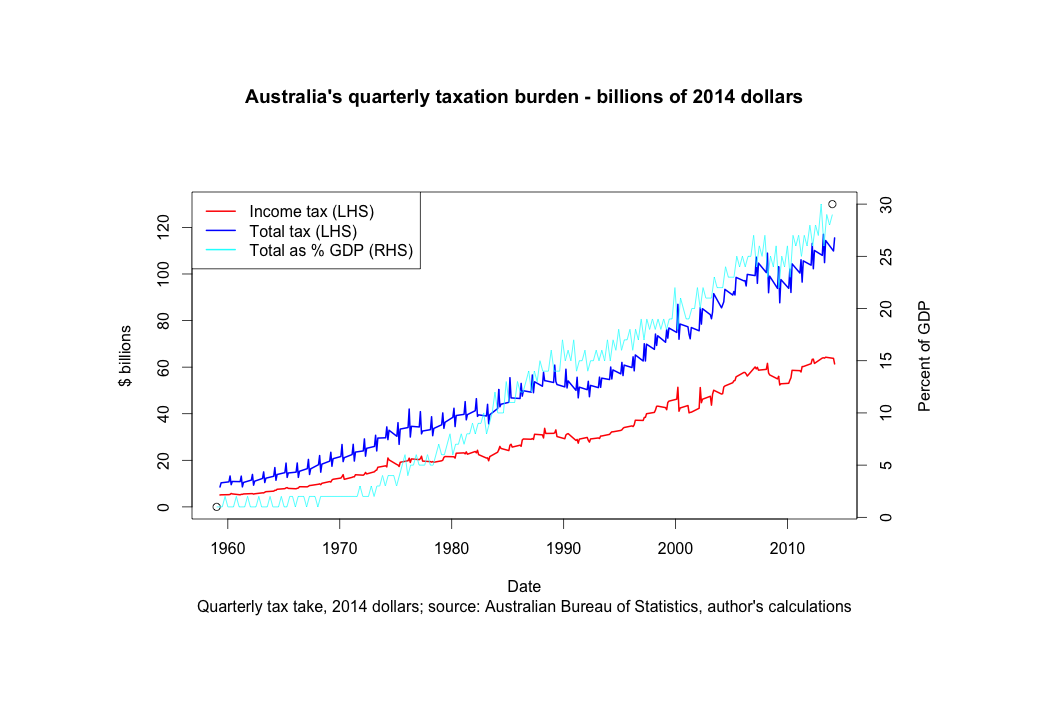
The tax burden in Australia has been on the rise for decades. In particular, the total tax take, expressed as a percentage of GDP, has accelerated from the early 1970s. The chart below has all dollars expressed in the equivalent 2014 values. The total tax burden has risen from around $10bn per quarter in 1960 to $27bn per quarter in mid 2014. Of this, income taxes have been rising, but not at the same rate as total taxes. The total tax burden as a percentage of GDP has risen over this period from 1% to 30%.

Rplot

This trend is unsustainable. No economy can survive an ever increasing tax burden. Some other countries have already passed a tipping point. Australian political leaders need to take note.

Environmental, Social and Governance (ESG) investing – watch out for zealotry

ESG. I’m glad someone came up with another acronym, because I find that in the field of investment, you can never have too many acronyms. This one clumps together the concept of including factors relating to the environment, society and governance into investment decisions. Sounds fair. The problem is that the ESG acronym is a magnet for zealotry.

On 3rd October 2014, the Australian National University announced that it would divest its holdings in 7 mining and resource stocks in its Australian equity portfolio. The reason given was that the University had reviewed its whole portfolio with reference to its Socially Responsible Investment Policy and this group of 7 were to be cut out as a result. Presumably , the blacklisted group did not meet the standards required by the ANU in its policy. This announcement has caused a stir in Australian investment and political circles. The ANU has been criticised, as has its advisor, by commentators, political figures and some of the 7 companies themselves. There is at least one court action underway and there could be further lessons to come out of the process when it is finally over.

In the meantime, if any person investing under a fiduciary duty (eg a superannuation trustee) or as an agent of a principal (eg company executives investing company money) uses ESG principles as a filter to determine the investment universe, in my view they are in breach of their duties. If ESG is elevated to the first criterion and a possible investment is excluded on those grounds alone, regardless of its other prospects, that is a breach of duties. Normally, a decision to invest (or divest) is made after reviewing many factors and ranking alternative investments to get the best possible mix. Factors that we now refer to as ESG factors are almost always included in that assessment, provided they are sufficiently material.  But ESG has the potential to attract zealots who, by virtue of their own personal beliefs, want to exclude certain investments altogether. Specifically, fossil fuels, mining, tobacco and gambling stocks are at risk. ESG advocates want to raise all ESG factors to be the first criterion and only if the company passes those tests does it remain to be assessed against other factors. It is not good enough, according to the ESG advocates, that ESG factors are not given preferential treatment.

Continue reading

The rise and rise of risk aversion

Writing in 1896, Norwood Young opined in the Badminton Magazine that:

“A great change is gradually coming over the world. Adventure, sport, enterprise, are giving way to caution and the calculation of averages. Men do not take the risks they used to. The modern man is surrounded by police constables, sanitary inspectors, and insurance agents.”

Granted, the Badminton Magazine, with full title ‘The Badminton Library of Sports and Pastimes’ was a journal that covered in full detail the adventures of the day, with detailed articles on sports such as cricket, football and rowing, but also shooting, motor racing and cycling. It was both a manual and celebration of adventure. Norwood was clearly miffed that the sporting attitude and  let’s have a go mentality was on the wane. He may have been premature – he wrote this before Scott, Shackleton, Amundsen et al set off on foot in their various adventures to find the South Magnetic Pole.

Fast forward to 2014 and listen to the character Cooper in the film Interstellar complaining that “It’s like we’ve forgotten who we are – explorers and pioneers, not caretakers.”

More than 100 years passed between the writing of the essay in the Badminton Magazine and the writing of the Interstellar screenplay. Yet both spring from the same yearning, the same perception, the same disappointment.  It is too easy to dismiss these views as the misconceived grumblings of individuals who never grew up and never moved on from boyhood adventure games and fantasy. Great adventures are still planned and undertaken today but society makes it much harder for those individuals than ever before. It is inconceivable that anyone would set off today on the equivalent of a South Pole exploration so ill-equipped as were Scott and his team. ‘The authorities’ would not permit it. When young sailors plotted a trans-ocean adventure 50 years ago, the media didn’t know about the trip until after it was completed, as was the case for Robin Lee Graham. Today, in some cases courts of law intervene to ban the planned trip, as in the case of Laura Dekker. In others, community anger and backlash against the trips can be feral, as was the case with Jessica Watson. Continue reading

Oil prices – an economics lesson with potentially serious outcomes

The fall in oil prices over the last six months has been extraordinary. West Texas Intermediate crude oil, a generally accepted benchmark price,  was trading around US$100 per barrel for the last 5 years, with some volatility, but from August 2014 has appeared to be in free-fall. The price is now just above US$50. Is this excessive volatility ahead of a return to price levels of around US$100 or is it a new normal pricing level? Will it fall further? How will the suppliers react? What happens to the oil price in 2015 is vitally important to the world’s political power plays. In certain scenarios, the potential outcomes are serious.

The immediate effects of the fall in prices are noticeable at the petrol station. It costs quite a bit less to fill the car’s tank when street prices (in Melbourne) have fallen from about 150 cents per litre to 115 cents. Those of us driving V8 engined cars are very happy about that. (Those in their green hybrids are metaphorically fuming, but that is another story.) Cheaper energy prices benefit consumers – heating, cooling, cooking, transport etc all become more affordable. While this allows people relatively rich western societies to spend more on non-essentials, for the poorer societies, it can bring people out of poverty and subsistence living.

For economies that generate national income from the sale of oil, such as the OPEC members, Russia, Nigeria and others, the price fall results in a serious hit to revenues. Oil producers, and the many elements of an economy that service those producers, are going through a very substantial enforced reorganisation to avoid collapse. Nationally, this results in reduced state revenue from falling tax revenues, duties, royalties etc. The adjustment in the labour sector as workers are laid off creates increased pressure for Government assistance payments and other spending pressures. For an economy that is heavily dependent on oil revenue, the benefits of cheaper prices will not be enough to offset the pain of such a hit to GDP.

There has been chatter about the reasons behind the price fall. One of the most bizarre comes from the President of Iran who believes that there is a conspiracy against Islamic countries in the middle east. He fails to nominate who is behind the conspiracy and how it is being effected. Others, such as the President of Russia, believe Russia is the target of pay-back for its meddling in Ukraine. This shows the political pressure those leaders are feeling right now. More convincing are the arguments that point to a shift in the oil supply curve. Continue reading

Coded messages from across time

In bookcases, piano stools, boxes in the attic and at your grandmother’s place, sheets of code wait for an interpreter. When an interpreter is available, the code is transformed into an aural communication preserved immaculately from centuries ago.

When Frederic Chopin died in 1849, he had written many compositions of etudes, nocturnes, ballads and some concertos.  Chopin wrote almost exclusively for piano. While it is true that he was the equivalent of a musical superstar today, he achieved that status with very few public performances. He preferred to play alone or for small groups of friends.

Many of the musical giants of the Romantic era died young, often from bacterial infections such as tuberculosis and syphilis. Chopin died at age 39. Robert Schumann died at 49, Franz Schubert at 31. Chopin left behind some works that were yet to be published by the time of his death, at least some of which were published posthumously. That these composers were able to achieve what they did in such short life times is remarkable. Such constraint is not generally imposed on today’s musicians, even though in some cases it probbaly ought to be.

A solo piano performance of a Chopin piece is an intricate, complex and beautiful message that connects us with our past. A private studio in Paris in the 1840s in which Chopin composed his final works, refining them over and over to get the desired result, is connected to the suburban houses of the early 21st century where today’s pianists work hard to reproduce the same sound that Chopin himself created. Continue reading

The shape of mortality, updated

The Australian Government Actuary has released updated life tables of the Australian population based on the 2011 census. The media release is available at http://www.aga.gov.au/publications/life_table_2010-12/media_release.asp

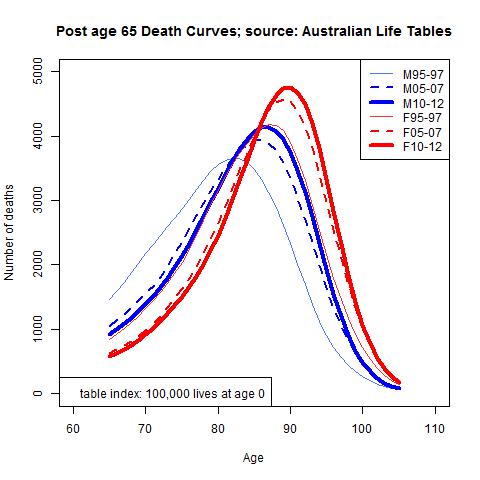
Continuing on a theme, I have updated my chart that shows the shape of mortality at older ages. The chart now shows the number of deaths at each age from 65, based on a standardized starting population of 100,000 at birth, over a 20 year period. The data is split for males and females.

There are some interesting conclusions to draw. Firstly, life expectancy continues to increase for both males and females but the improvements between 1995 and 2010 were more significant at older ages, ie from mid 80s and above. This is suggesting an increasing skew in the curve, with more people living to higher ages but then dying in greater numbers at those advanced ages. Secondly, the curve for men in 2010 now approximately matches the curve for women that existed based on 1995 data.

result

As always, while this has implications for retirement income planning at the policy level, it has less direct applicability at the individual level. Yes, it is true that life spans, on average, are increasing. But people don’t live according to averages.