Readers may recall that I said the Burnet Institute’s COVID modelling from September 2021 should be revisited in late October to check the actual outcomes against the modelling predictions. It is now late October. The following actual data is sourced from covidlive.com.au
Predicted deaths: 964
Actual deaths: 280
Predicted hospitalisations: 1,666
Actual: 738
Predicted intensive care cases: 360
Actual: 130
What does this comparison of actual against expected prove? The modelling was wrong, of course. It was wrong by a factor of around 3 in these measures. Modelling is just a guess based on certain assumptions. Burnet’s modelling was clearly poor quality, but many modellers around the world have been proven to be just as bad or worse. The real lesson is that modelling is not gospel truth and should not be held up as justification for a government coercion on the populace. Nor should the modelling be used to prove how effective those coercive measures were: ‘See how much worse it would have been had we not imposed the lockdown?’ Modelling may have some uses, but should only ever be one input among many. Modellers that have a track record of dud predictions should be treated with scepticism or, preferably, ignored.
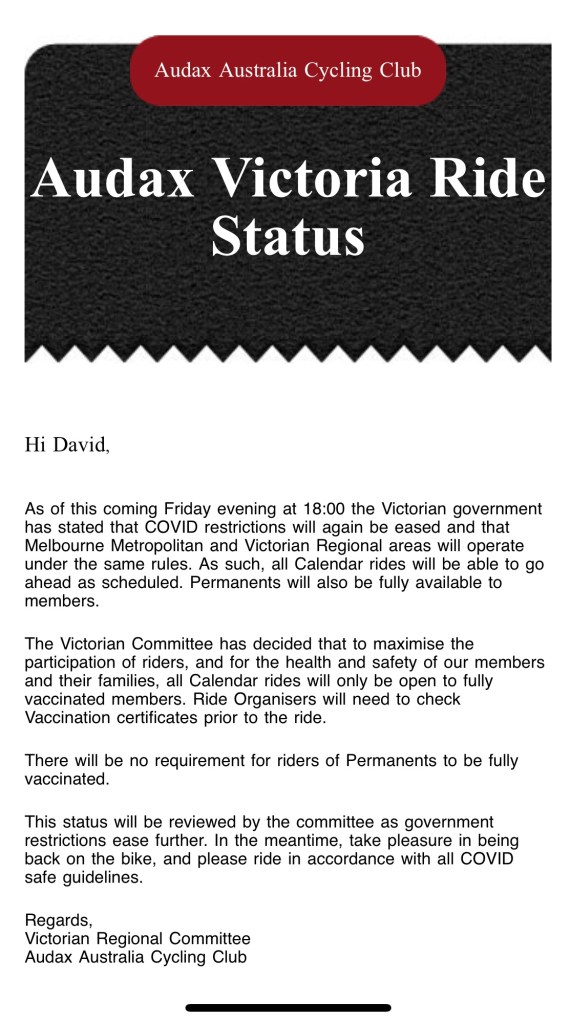
I received an email today from Audax Australia with some details about rides being opened up again in Victoria. The pith of the missive is shown below.
To the eagle-eyed reader, the exclusion of the unvaccinated from certain rides will be noted. Plus, such exclusion has been made for two reasons: increasing participation rates and safety.
I may be able to clarify the rationale if I get a response from Audax to my two questions: on what basis did the Committee determine that banning the unvaccinated will increase participation and on what basis will it increase the safety of riders and families?
I’m expecting a response soon. It should be a hoot.
In a Swedish study, the results of which are about to be published in the Lancet, vaccine effectiveness against COVID infection has been found to wane over 6 months. It is not obvious that there is any effect against infection beyond 6 months from date of full vaccination. Meanwhile, effectiveness against severe outcomes was found to wane over 9 months for men, older people and those with co-morbidities. The report is available here.
It seems that suddenly everybody is talking about inflation. Better late than never, I guess. In Australia, the inflation rate for the full year to 30 September 2021 was 3.1%. The September quarter price index rise was said to surprise economists and the bond market traders. Some Chief Executive Officers of large Australian companies have begone warning their consumers that price rises will be on-going. I know that in some industries, suppliers are giving notice of impending price rises closer to 10%. Producer prices are increasing rapidly and that will eventually feed its way into consumer prices. The Consumer Price Index is the favoured inflation measure of many people, but producer prices give a better lead indication. Continue reading →
I know that cognitive dissonance can stress some people so apologies in advance if these stories from today’s business news in Australia give you the jitters. But many people, like me, will find them funny and get a good old-fashioned guffaw out of them. Or at least a smirk.
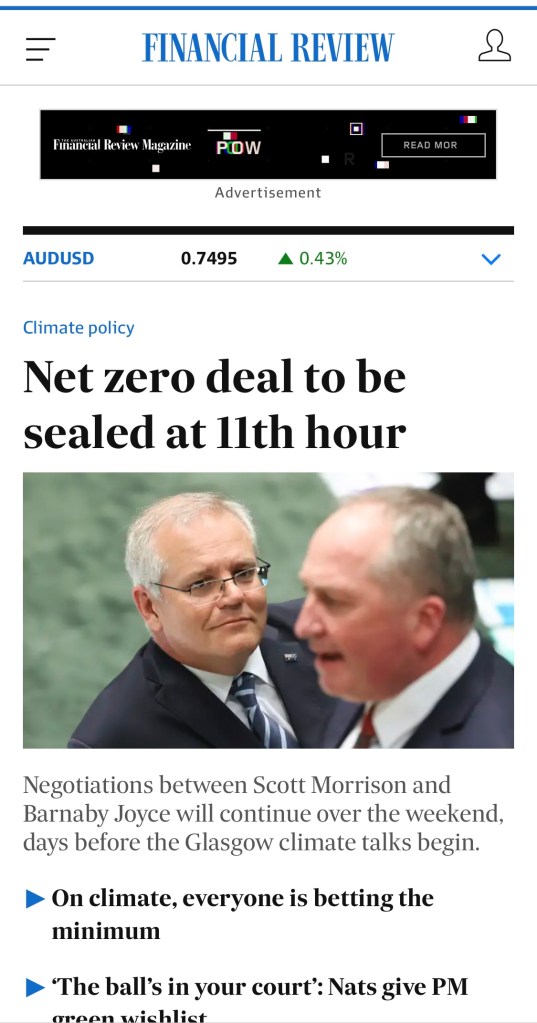
First, to corporate finance. A senior executive from the RBA, Australia’s central bank, gave a speech yesterday. That in itself is enough to prime most people for a laugh, given that many utterings from RBA senior executives are laughable. He said that Australia risked climate conscious global investors divesting from Australian business for greener opportunities. This is being referred to as a potential capital strike. I understand that he made these comments as a warning to Australian business for not being sufficiently green. But on the same page of the newspaper, a different report quoted the CEO of a major coal mining company saying the company is enjoying massive demand for its coal. That high demand, particularly in conjunction with rising prices, is creating booming revenue. Further, he said that with little increase in production of coal (globally) in recent years, this boom could last many years. In a previous post I mentioned that corporate finance options would evolve as traditional sources of finance were becoming, as the RBA man said, “climate conscious”. Sure enough, the coal executive explained how new sources of overseas capital are opening up, with particular emphasis on the likely long term funding from Asian debt capital markets to invest in and expand production capacity. I think the RBA chap should get out and about more.
Secondly, we turn to the current thorny issue of mandatory COVID vaccines for employees. Two of Australia’s four big banks were reported to have disclosed their policies. Westpac has introduced a compulsory jab policy. This was after it had surveyed its staff and found 91% were already fully or on their way to full vaccination status. According to the bank, the survey proved that the staff were supportive of this new policy which would keep everyone safe. Meanwhile, the ANZ bank also reported that it had surveyed its staff and it too found 91% on their way to full vaccination status. According to the bank, this showed a compulsory jab policy was not needed and it had no intentions of introducing one. So there you have it – how to interpret a survey result of 91% in two totally different ways.
Extraordinary claims require extraordinary evidence. Employment termination for not being vaccinated is surely sufficiently extraordinary to warrant demonstrable justification. If there is a case to justify firing an employee, then the data would support it. Right?
I can’t find any Australian data to support the mandate. Instead, I can see case numbers, deaths and vaccination rates. Take the following graphic from The Australian as typical. The curious reader might want to know if the increase in average daily new cases is different between the vaccinated and the unvaccinated, particularly among the ages of the workforce. I can’t find that breakdown in official data, although of course it will exist.
If the case numbers were much higher among the unvaccinated compared to the vaccinated, that would be helpful data to convince the public of the need for vaccination. If any readers know of the split, I’d appreciate a pointer to the data in the comments. Why the Australian state governments do not publish this is a mystery to me. Unless Occam’s Razor strikes again.
However, the UK health authority does publish its data.
This monthly snapshot shows infection rates split by age band and by vaccination status. Look at the last two columns. This is unlikely to convince the remaining unvaccinated to get vaccinated. Maybe a breakdown of deaths by age band and vaccination status would help? Again, this data will exist in Australia but I can’t find it. Thanks again to UK Health, here it is for the same monthly snapshot:
UK Health, ibid
Is the Australian data similar to this? Someone clearly knows. The UK experience shows a couple of things:
The vaccines do not prevent infection. The case rate among the vaccinated vs unvaccinated was around 50% in the above UK data. Removing the under 18s from the rate sees it change such that the unvaccinated represented 16% of the cases. (The under 18 data is highly skewed to the unvaccinated and is therefore less reliable in this analysis.)
The mortality differences between the vaccinated and unvaccinated are negligible until after the age of 50. The survival rate for unvaccinated people in the 50-59 age band is 99.99%. This reduces to 99.94% for 70-79 year olds. Even above age 80, which includes those who have already lived beyond current life expectancy, the survival rate is 85% for the unvaccinated.
The virus continues to be an old person’s disease. Youth and the workforce are largely unaffected by being infected.
There is no case for mandatory vaccination presented here. Any business that terminates an employee for not being vaccinated risks a serious legal backlash down the road. If that were not the case, then the data to support such actions would be in the public domain.


 Australian Actuary