The long roadside grasses have gone to seed. As I drive, an approaching speedy motorist flashes into view from around the corner, in the middle of the narrow road. We both take evasive action.
My antagonist appears to be familiar with the routine. He dodges me, toots, remonstrates via hand gestures and speeds on as if nothing had happened. I take a moment to recover myself. I am in southern Italy, in the Basilicata region.
I had arrived a few days earlier in the eastern coastal city of Bari. A well prepared traveller would not enter Italy without a functioning smartphone and some Euro currency. I’m not a well prepared traveller. So it came to pass I was driving from the airport in a prepaid hirecar, at night with no GPS, no phone and no cash, other than some Turkish lira and Australian dollars (ed. note: who would want them?). I asked a passing couple if they could help. I have found that in non English speaking countries, whenever I ask a local if they speak English, they say “A little”. They all say that, typically with a short non committal head gesture. “A little, I get by.”
“Parli Inglese?”, I ask. “A little.” they respond, with a short non committal head gesture, and then resort to Google translate. Fortunately, the couple helped.
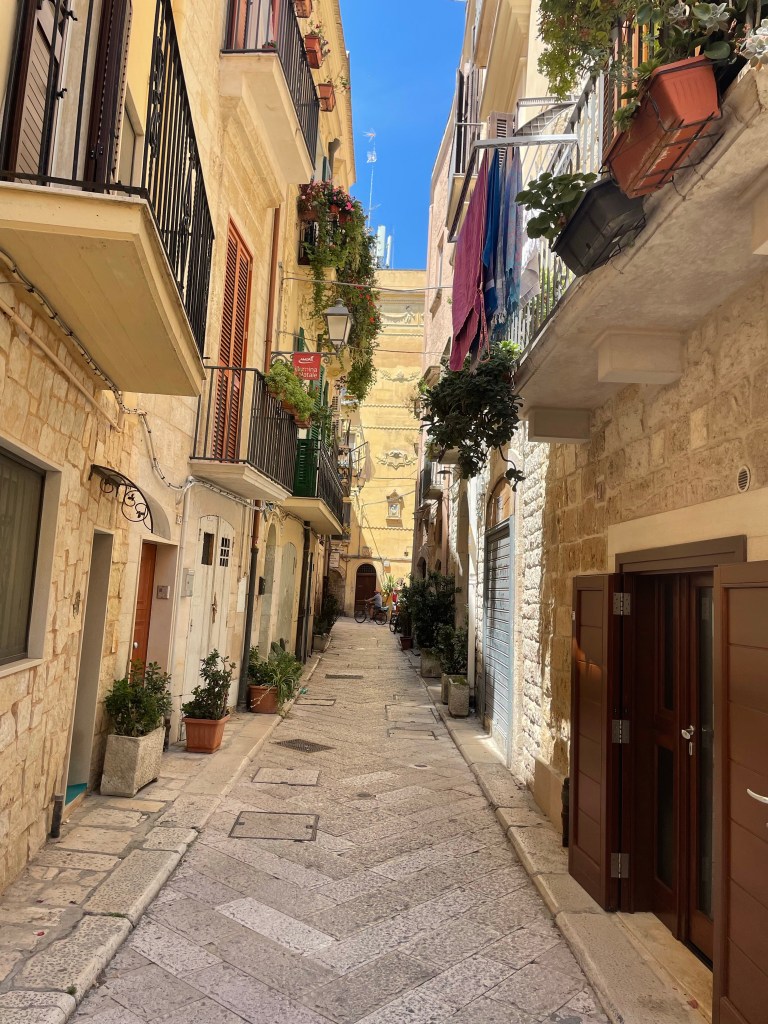
Bari is a city of perhaps 60,000 people and only one free car park. I spotted it, as it stood aloof with its large electric vehicle charging point sign painted on the road. It was empty. Yet everywhere else in Bari was jammed full with cars. There is nowhere to park. Locals overcome this problem by stopping in the street, turning on hazard flashers and leaving their car. Or, parking on a pedestrian crossing. Or, in the middle of an intersection.
The streets of the city central are regular. Mostly narrow, but with some wider boulevards, home to Governor’s Mansions and similar impressive buildings. The buildings do not exceed three storeys, but each storey is tall, high ceilinged, with tall external window shutters painted green and balconies. The sandstone walls are washed with a thin colour of yellow, apricot or sometimes blue.
Early in the morning, the city is shuttered, deserted, nobody around. There is very little commercial street signage. The city appears abandoned. But as if a bell is sounded, at 8:30am the shutters swing back, the shops, stores, cafes, open up almost simultaneously and the city suddenly hustles with people that have come from nowhere. Vespa motor scooters buzz by, the male rider typically wearing a straw trilby hat, the female rider letting her dark hair flow in the breeze.
Later, the Adriatic Sea is glassy smooth and blue as I enjoy a coastal gelati near the boat harbour. It was from this harbour that many of the Crusades were launched eastward towards the Holy Land. Finally, with money and phone sorted, I am ready to venture west.
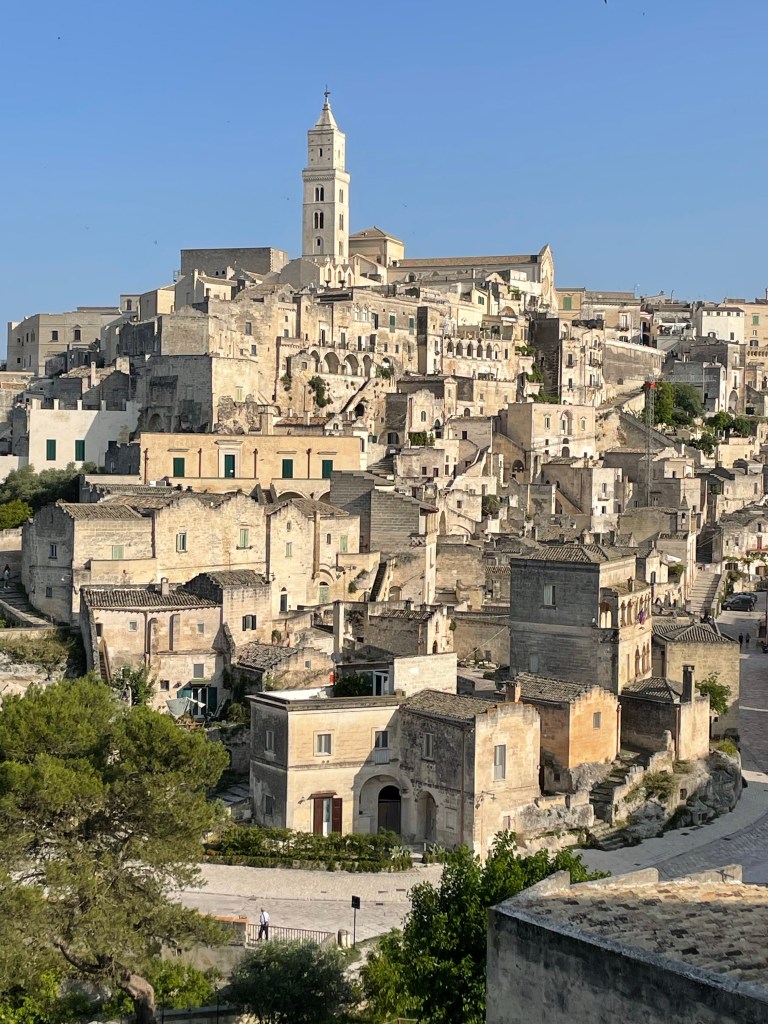
I arrive in Matera in the midday searing heat. The city was once the poorest in the whole of Italy, with residents living in caves carved out of the limestone sidewalls of a massive gorge. These caves were inhabited for thousands of years and remained so even as the Romans built the ‘new’ city from the time of 1,000AD onwards. It wasn’t until the twentieth century that Italy’s rulers deemed the poverty of the cave dwellers a national embarrassment and forcibly removed them and housed them in modern multi-storey blocks of flats up on the plain. These days, the flats are the embarrassment and the sassi, the cave dwellings and the ‘new’ city built on the sides of the gorge, are a middle class source of tourism euros. High quality restaurants and cafes, movie set scenes used by many film studios, including James Bond productions, all enjoy this renaissance of an ancient site.
As I work southwest, I am in the heart of the Basilicata region. This is the area of poor quality soils, hilly Appenines, poverty and hill top villages. It is Calabrian, Sicilian, Basilicatan tough terrain. I explore the valley between two hill top villages. The grapes are just forming on the vines. The grass is being cut for hay. Freshly cut grass drying in small fields sends out that especially sweet smell early in the morning. The local dogs, unused to early morning explorers, react differently. It is generally true, and certainly true of the dogs in the Basilicata region, that dogs short in stature are the ones that house maximum outrage. Small yappy dogs are apoplectic that I should go past their owners’ place. They let me know that I would be in real trouble if only they weren’t shut inside the garden. Meanwhile, the large dogs just watch me pass by.
This is still an area of small farms. Small tractors with narrow implements, small three wheeler utility vehicles with two stroke engines that announce noise rather than speed, hand hoeing small corner plots and impossibly narrow laneways. The post World War II development push still has some way to go before rubbing out the traditional southern Italian ways. Included in the Italian way is the afternoon reposo, or siesta. After a morning of activity, hectic because it started late, Italians ease into a leisurely lunch followed by a reposo. Most shops shut for several hours and the locals disappear. The tourist is left to wander around in bewilderment wondering where everyone is. The thirsty tourist shouldn’t count on relief until 7:30pm. At that time, the cafes and restaurants open up again for trade. It is the Italian way. Do not question it; that is considered rude.
Windmills are common on hill tops in this region. Oil wells are common in the valleys. Italy is one of Europe’s top oil producing nations and the Basilicata region is where the bulk of the oil comes from. Refined fuels from crude oil make up one of the top 5 exports of the country. Since WWII, Italy’s electricity has been generated almost entirely by oil, coal and gas. Today, gas and oil are used in similar measure. Wind produces about 3% of Italian power needs.
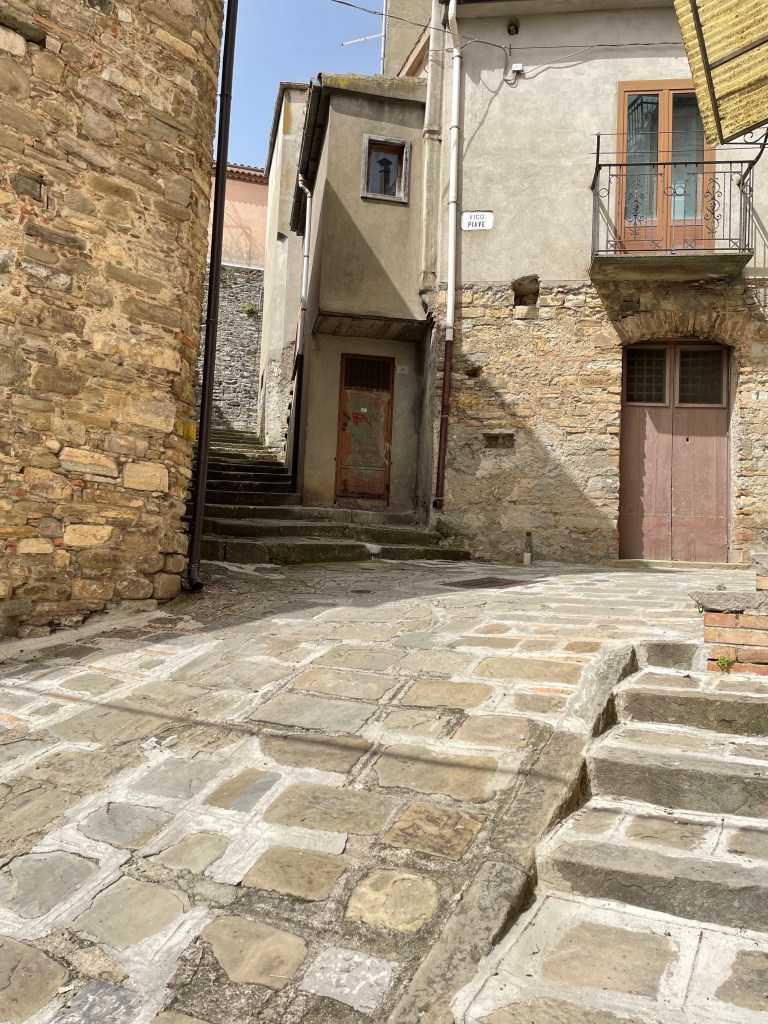
In this region of Italy, the English speaking traveler will rely heavily on google translate. That works well in some circumstances but not all. Give a false impression to a passerby by saying ‘Bongiorno’ with style is to invite a return stream of Italian delivered at rapid pace. My face must betray the inability of my mind to get beyond two or three words. Emphasising words with hand gestures only confuses the matter further. ‘Arrividerci’ is my lame comeback. But I did find a fellow traveler in the hilltop village of Viggiano who found my halting German was more understandable to him than either my English or Italian. I had cause to seek help in Viggiano to get my car out of the narrow cobbled laneways when I had become lost.
The bells ring close by but I cannot yet see the church. I am approaching the summit of the Sacred Mountain of Viggiano, shrouded in low cloud. Out of the mist, the church finally appears. This small church on the summit is accessible by a winding steep pathway and is home to the Black Madonna during summer. In winter, the Madonna is housed in the main church in Viggiano.
The Madonna statue is carved out of dark wood and ornately dressed, with plentiful gold leaf. She and infant Jesus on her knee are housed in an elaborate carriage case. Her legendary status dates from before 6th century. Originally carved by early Roman settlers in Grumentum, in the face of Saracen attacks of the 8th century, Grumentum was abandoned and Madonna was hidden for safety on the mountain, Three centuries were to pass before she was rediscovered. When the region was once more predominantly Christian, Madonna was celebrated and eventually adored by the people of the Basilicata.
Every spring a pilgrimage transports her from Viggiano to her sanctuary on the mount. That is a journey of about 12 km and she is carried by 12 men, who rotate in teams to cope with the physical strain of the journey up the mountain. Hundreds of people accompany the Madonna on her journey. In autumn, she is carried back to Viggiano.

I’m grateful for not having to carry very much up the mountain. Despite having driven to the car park available, the final 1.5km walk to the summit is taxing. Today, Sunday, large groups of people are on their own pilgrimage. They are lead in prayer and song by a church leader as they make the slow journey up the hill. The breathless are excused from singing. Frequent rest stops are required.
While preparing to leave the Basilicata region, I take my reposo in the shade of an olive tree at the side of my villa. Garibaldi and his troops passed this way on his march north from Sicily in his final revolutionary campaign to achieve Italian unification. There seems to be no village in southern Italy without several streets named in Garibaldi’s honour. Nationalist republican, hero to many. In the corner bookcase of my villa, I note an Italian language copy of an Ayn Rand novel.
 Australian Actuary