I’m standing on the stony English beachfront at Deal, Kent, on a clear summer morning. France is visible over the water. I keep a watchful eye on that foreign treacherous land.
Beside me is a monument to Julius Caesar, who is thought to have landed here in AD 55 before going on to successfully establish the western extent of the Roman Empire. Not that he had it all his own way. In AD54, he tried landing but was repelled.
The Romans were not good sailors. And the English Channel is not an easy place to sail. The tide races through one way at up to 10 knots at times and then reverses, before reversing again. And again. Six hours this way, six that way. Repeat ad nauseum. Little wonder the initial Roman invasion failed. Julius returned the next year better prepared. The Britons were then subjugated under Roman rule for 400 years.
After the Roman western empire collapsed, another 600 years passed before further invasion. But the Normans, being French, were better sailors than the Romans. William the Conqueror of Normandy invaded England in 1066. He fought Harold at Hastings, which is just around the Dover corner from Deal. Now, I don’t want to be judgemental but if I had my choice, I’d prefer my warrior leaders to have names other than William or Harold. Thor sounds good. Boadicea is good. Hannibal is good. But William? Or Harold?

Anyway, William prevailed over Harold and although he went on to build Westminster Abbey among others, the Norman invasion was ultimately unsuccessful. The coastal town of Deal didn’t have to contend with potential invasions after Will until 1940 when Germany took an interest in invading. Coastal German artillery guns stationed on the French coast after France’s surrender were capable of hitting England across the Channel. Around the corner from where I’m staying in West St, Deal is Robert St. A German artillery shell hit a house here in 1940 killing all 12 inhabitants. Hundreds of people in Deal were killed during German shelling in the early years of World War II.
The day before I arrived in Deal, I was in Dunkirk, France on the other side of the Channel. I walked on that wide beach down to the water where the British Expeditionary Force was evacuated at the end of May 1940. A potential catastrophe was avoided by a series of decisions partly by good luck, partly by good military planning, partly by exceptional resistance of French and British forces, partly by an inexplicable German pause and partly by a volunteer flotilla of small private boats from England that crossed the Channel to collect and return as many British soldiers as possible. Over 300,000 British infantry had been exposed on that tiny corner of France, taken by surprise by the French surrender. The evacuation saved the British Army. It was an extraordinary success. But PM Churchill reminded the nation that wars are not won by evacuations.
The French fields on approach to Dunkirk are flat. Only 25 years prior to the Germans overrunning France in World War II, these fields were almost obliterated by first World War trench warfare. I stop to peruse the headstones in several cemeteries of young men killed in that abomination. Private, aged 19. Corporal, aged 21. Unknown soldier. Royal Dublin Fusilier. Royal Welsh. Scots Guards. Australian Army. Canadian, New Zealand, English, French, Belgian. It goes on. The tiny stone memorial crosses reach out in all directions. Some have a small flower recently placed in honour or memory or both. The appalling killing of early 20th century trench warfare was repeated a generation later.
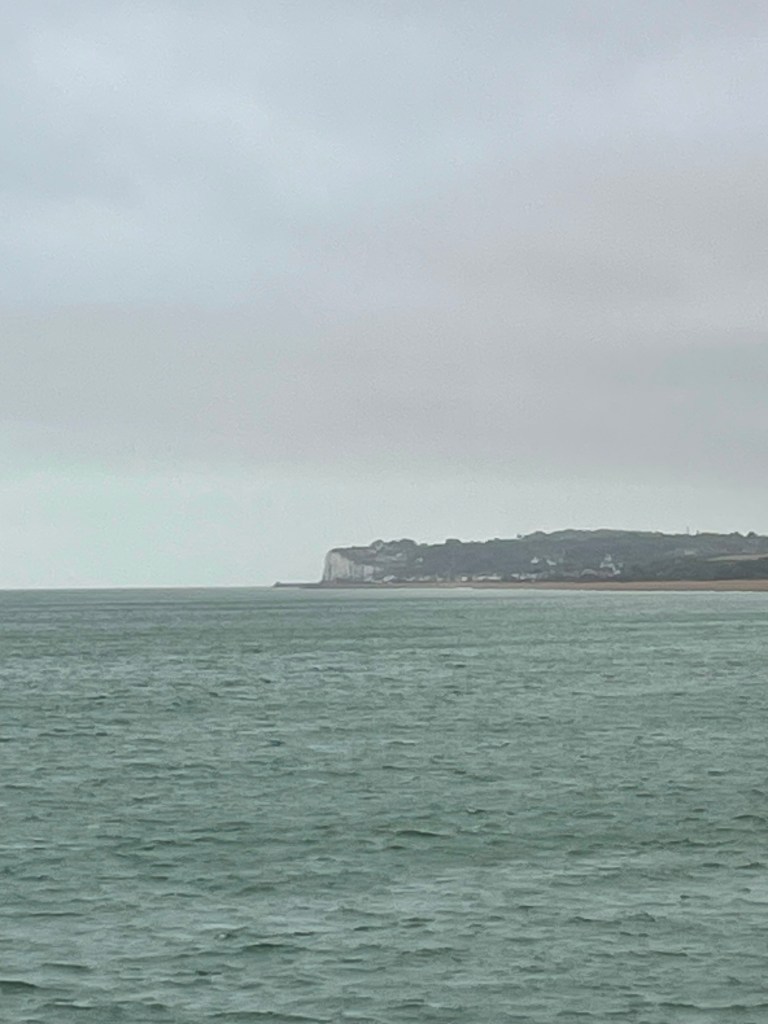
The town of Deal was once among the most important Naval Establishments on the southeastern corner of England. The Goodwin Sands just offshore, created a sheltered water area that was used as an anchorage by the Navy since before the Napoleonic Wars. William Penn, later of Pennsylvania, US, sailed from Deal in 1682. Several castles remain here, built on the orders of Henry VIII, to guard against and repel foreign invasion. I wander around some of those castles admiring middle age masonry.
The walking path along the beachfront has numerous seats for the weary walker to stop and rest. They all face France. Runners, walkers, cyclists all rush past. But some seats are occupied by people staring out over the water. Typically older and perhaps remembering the defensive actions of their forebears.
 Australian Actuary