We’ve been here before, right?


In the 1930s, the authoritarian forces of Nazism, Fascism and Communism were in the ascendency in Europe. A doctrine that became common to all of the architects and proponents of these ideologies was that the state must not be bound by the law. The rule of law neccessarily meant that the state was unfree. Giacomo Perticone put it this way in 1931: “During the whole of the evolution of judicial thought, one was led to the conclusion that a regime of law was one in which the State was a prisoner of the law, and as a consequence incapable of action, of will, of power, a State indecisive, emasculated and all that which follows.” It followed that a State bound by the rule of law was unfree and to be free to act justly it must not be subject to the obligation to follow the law. In other words, the State should be able to treat citizens exactly as it pleased. [Ref FA Hayek, The Constitution of Liberty]

The proponents and leaders of these totalitarian forces thus justified their right to ignore the concept of the rule of law. At a basic level, the rule of law can be considered as a legal system in which everyone is treated equally before the law, whether it be statute or common. The totalitarians devised their own justification for doing exactly the opposite. Orwell’s oft-quoted sentence from Animal Farm reads: “All animals are equal, but some animals are more equal than others.” The sentence captured both the concept of differing treatment and the abuse of language to maintain a power hierarchy and authority to coerce others.

Continue reading
We only have 10 years left to save the planet

Look, I know that we’ve only had 10 years left to avert global catastrophe for at least the last 30 years and so I will understand it if you are becoming jaded by such screaming headlines. But trust me, this is serious.

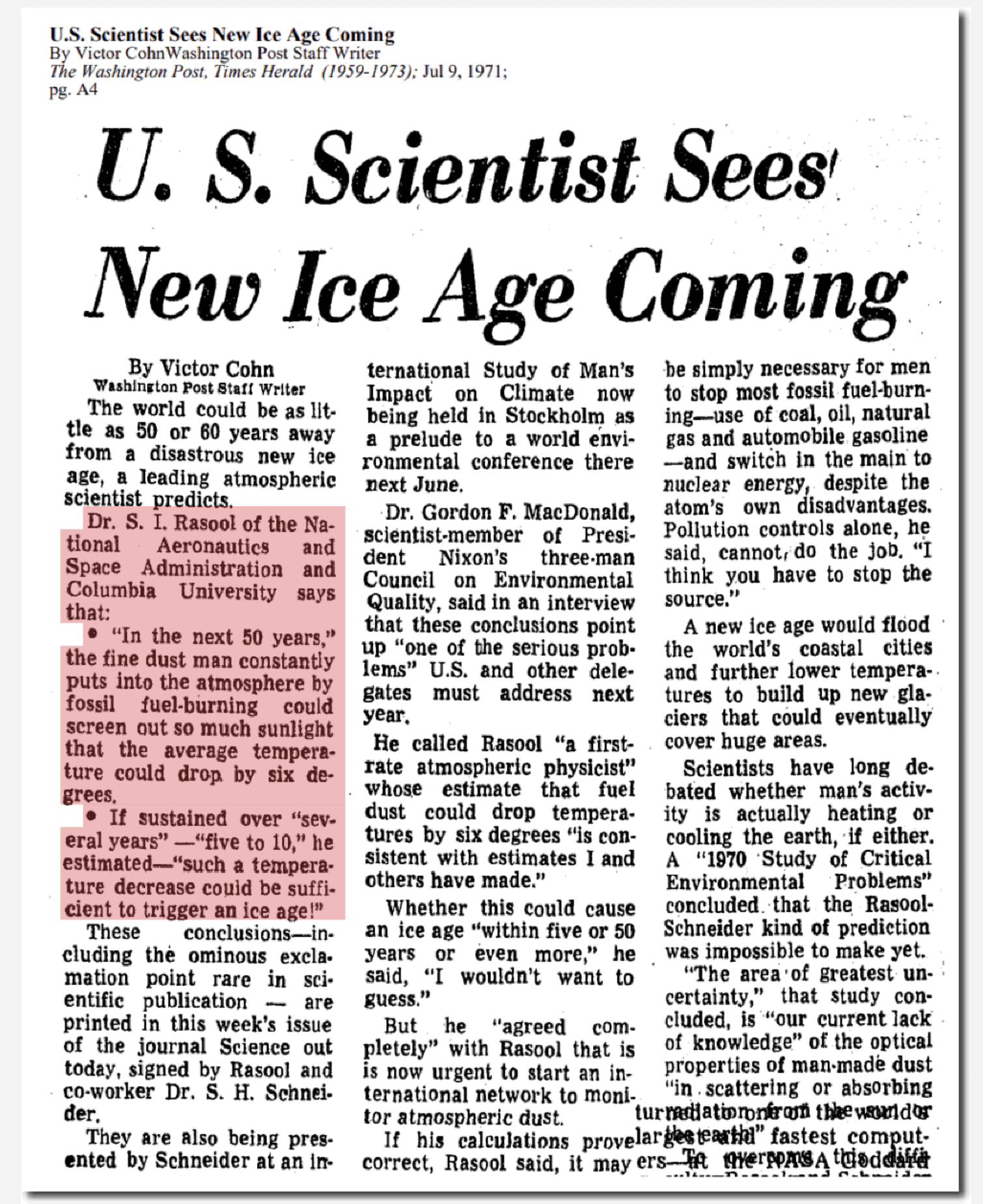
The scientific research reported by The Washington Post in 1971 (see below) stated that burning fossil fuels would likely cause a disastrous new ice age within 50 or 60 years. We have just passed the 50 years mark. So we only have 10 years left.

The continuing evolution of corporate finance

Australia's major banks have signalled their intention to stop financing businesses that they, the banks, see as problematic for climate change. These are resources businesses in projects related to fossil fuels such as coal, oil and gas. During proceedings in a Parliamentary Committee hearing last week, the committee heard evidence that such businesses were increasingly turning to private equity and foreign sources of finance.

I think this trend will accelerate. Public companies, particularly the big retail banks in Australia, have seen their shareholder registers evolve over recent decades. The number of shareholders has increased, the average age of shareholders has reduced and the average shareownership value has reduced. Further, Australian superannuation funds have vast numbers of members that are willing to look through the investment portfolios of their fund to see where the investments are actually being made. Shareholders have become more diverse and, inevitably, many have organised themselves into shareholder activist groups. They put pressure on boards via various means to abandon fossil fuel investments.

Most of the directors and senior executives of public companies and the superannuation funds appear to be frightened of shareholder activist groups. It is hard think of any other reason for those entities to denounce fossil fuel projects as a class of investment.  Investment decisions ought to be made on a case by case basis. To impose a ban on financing a certain class of investment is not operating case by case. It is operating according to a bias.  I have no sympathies for corporate leaders who are scared of the prospect of a twitter storm or other noisy attention. The need to appear virtuous has superseded all other investment objectives if whole classes of projects are simply put off limits. That is weak, and possibly in breach of their duties. When you see a corporate entity claiming sustainability virtue points by selling off their coal investments, you see duplicity in action: selling a coal investment to another party is simply taking all future profits now in one net present value lump sum. If those companies genuinely believed the coal project in question should not exist, then it should be shut, dismantled and cleaned up. It should not be sold as a going concern.

Meanwhile, private equity executives do not need to even consider the issue of shareholder activists. They don't exist in the business model. They can make financing decisions based on a project's merits. In some respects, that is closer to how publicly listed banks used to finance business before the revolution in the shareholder base. I anticipate the on-going evolution of financing options. To be sure, the objectives of private equity are different from those of the high street banks but the end result will be the same: worthwhile projects will get their finances arranged. The projects will continue. While the public banks will withdraw, other financiers will step in. The activists will eventually realise that the game moved on while they thought they were winning.


A better roadmap

The Prime Minister's roadmap out of COVID19 and back to normal has been framed within a pretense of knowledge: that governments know best. It clearly foresees the continued use of coercive powers over citizens. This will be counterproductive and extend Australia's misery.

If the World Health Organisation had not changed its definition of pandemic in 2009, COVID19 would no longer be classified as such. Hence, national emergency powers would have been rescinded. The change in definition allowed emergency powers to be maintained, not on the basis of what actually was happening with infections, illness and mortality but on the basis of what might happen. The end result is what we see in Australia right now - 15 million or more people in lockdown in the face of how many actual deaths this year? The answer is twenty one.
An effective roadmap back to normal would begin today with the declaration that the pandemic is over and responsibility for personal health is now handed back to individual people. There is ample knowledge and good sense in the community. People are smart enough to make their own risk-adjusted decisions and mitigations. The real roadmap starts with this acknowledgement. 

Vaccinations do not prevent virus transmission – according to the CDC

The director of the US Centre for Disease Control has confirmed on CNN that vaccines do not prevent the vaccinated from being infected and spreading COVID19.

See this short clip from the interview.

Which means that as a strategy to suppress or eliminate the virus, vaccinations don’t work. Further, vaccination passports and similar restrictions on the unvaccinated would be unnecessary and unjust discrimination.

Truman’s attitude has infected current political leaders to the point of madness

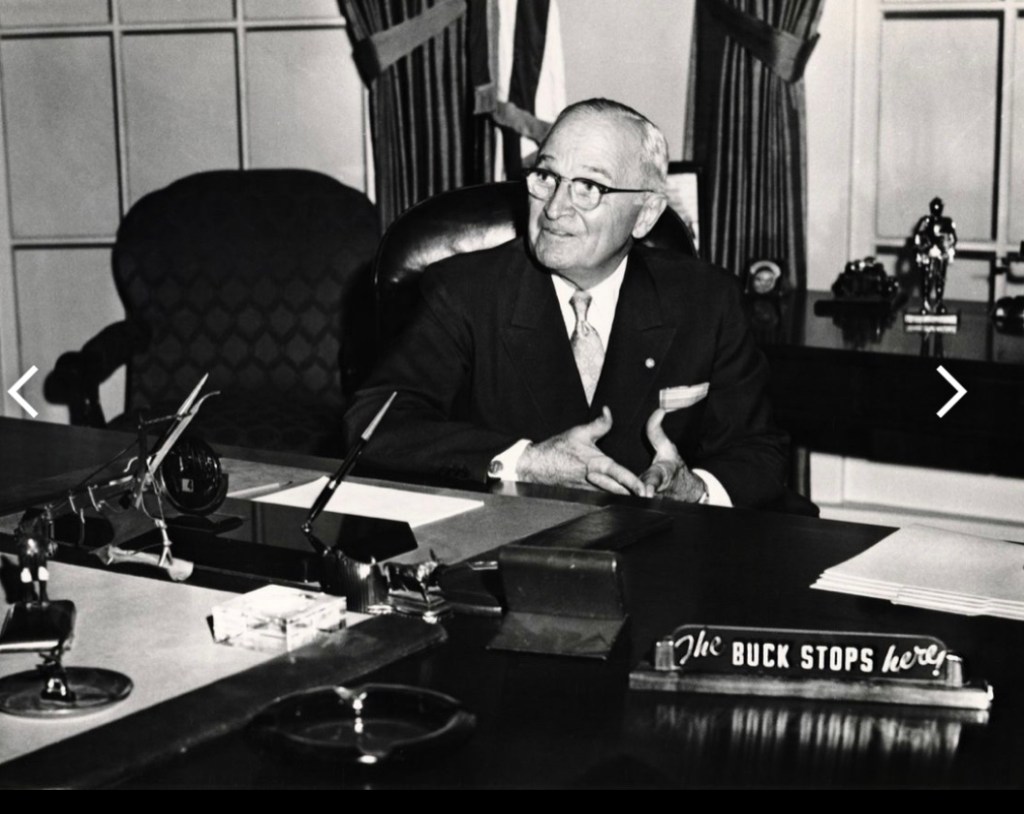
The buck stops here.

President Truman’s sign on his desk. He meant that he was responsible for the decisions and if things went wrong he couldn’t blame anyone else. (What a fantastic film emulsion. I wonder if that photo was shot on the famous Ferrania P30 film? The emulsion is back in production and I have some on order. ISO 80. Classic Italian film look. But, I digress…)

It’s a sentiment that is admirable in times of national emergency. But nearly two years down the track after COVID19 first emerged, there is no longer a national emergency. Or international emergency.

Responsibility for keeping the noses of the public clean should now be handed back to the individual owner of each nose. It is no longer a matter for any politician. Anywhere.

Targeted Risk Mitigation

I am unaware of any country other than Sweden that has taken a targeted risk mitigation strategy to deal with SARS-COV-2. It appears to me that the citizens of other countries have been treated as amorphous, to be pummelled towards the impossible goal of virus elimination. “We had to destroy the village in order to save it.” That cliched quotation, supposedly from a US army general in Vietnam, may be a myth, but it does describe the apparent attitude of most governments in response to COVID19.

Risk mitigation has costs. Therefore, mitigation techniques should be applied only where they are needed and only if they can be reasonably expected to work.

Using Europe as an example, here is the median age data by country:

Across the continent, the median age is less than 44. (It has created up to around 46 in some countries.) That means more than half the European population is aged less than 44.

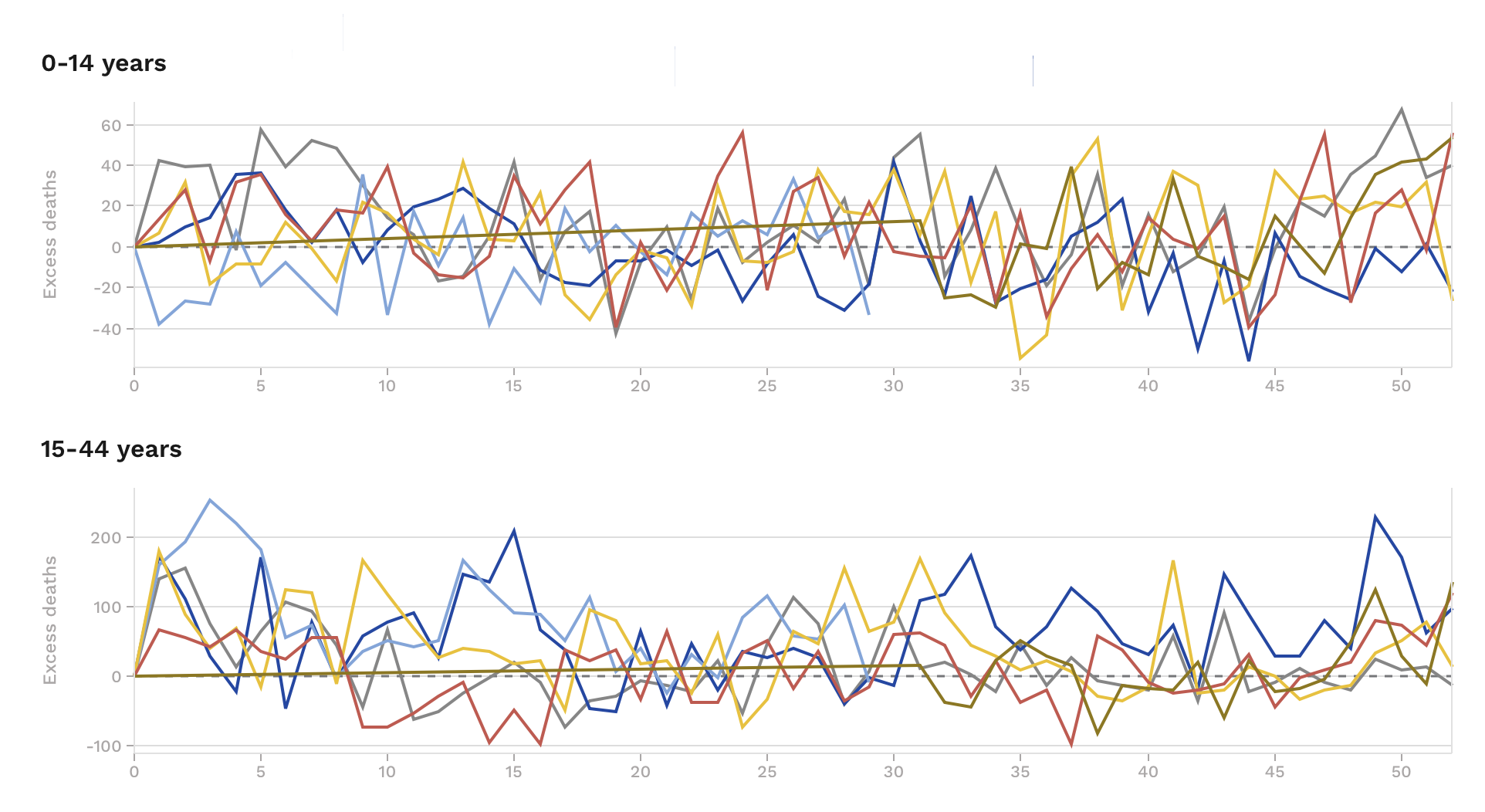
With that in mind, consider the mortality experience of the last 5 years up to the end of 2020, plus year to date 2021. This comes from the European Mortality Monitoring study that collects data from 29 participating countries. The following chart shows excess deaths (ie different from normal, where normal is based on continuous mortality investigations) for ages up to 44. Each line represents a calendar year of data, split by weeks 1 to 52. I have deliberately withheld the legend so that the lines are not identifiable as any particular year. Your challenge is to guess which coloured lines represent 2020 and 2021.

This analysis ought to inform policy response and mitigation targets. More than half the population is being hammered financially, psychologically and socially unnecessarily.

Global hegemony

When it comes to global hegemony the main event is the US and China. This will remain the case for the foreseeable future. China has been making its objectives increasingly clear in recent years and I anticipate that pattern will continue and probably accelerate.

Demography is destiny, as the French chap Comte once said. The pattern of demography and wealth follows a well established path: as countries get richer, the fertility rate reduces, which results in an ageing shift in the country’s population structure until a new equilibrium is established. Of course, some countries adopt a high immigration policy to keep up the supply of younger to middle aged people. That works only if the country maintains that rate of immigration indefinitely. Australia and the US are immigrant nations. China, on the other hand is not. There are no queues at the immigration counters in China. Border security officers in China assigned to the immigration desk have one of the world’s most boring jobs.

So China’s population shape depends entirely on the fertility rate. And here lies the tricky issue. Take a look at the following chart of the US population structure, both historical and with UN projections to 2100.

The total population is growing. The workforce age cohort (25-64) is growing. The retiree cohort (age 65+ is growing but does not get too close to the workforce cohort numbers. Having a healthy surplus of workers to retirees, students and children is essential for economic vitality, growth and social cohesion.

Now look at the equivalent chart for China.

The workforce cohort (25-64) has already peaked and is now falling. That’s a big deal. Meanwhile, the retirees are growing in number. There is a rapid squeeze that will take a grip of the Chinese population structure over the next 40 years and generate really difficult economic constraints. A lot of China’s growth in the last 30 years has come from a transition of agricultural labour into industrial labour to support new manufacturing of goods that have been exported all over the world. That transition is largely complete. There is no easy source of new cheap labour still making its way to the industrial cities. Productivity gains and new investment will be the only sources of future growth. But a demographic structure as projected by the UN combined with a Communist state do not give me much hope that the Chinese people will be able to match the productivity gains of a liberal democracy.

China could well be the first country to grow old before it grows wealthy.

Now, I don’t expect the Chinese Communist Party to meekly roll over and say “Oh well, we tried.” Communist regimes fail – that much we know. But they don’t go quietly.

The panicked Australian political leaders and public health experts (sic)

Most of the population of Australia remains in a COVID19-related lockdown that is unjustifiable by any measure. I wonder if any of those people bring facts into their thinking process? To give an update, here are three charts. I have shown data for Australia, UK and US.

First, the number of new cases:

Next, the proportion of those new cases that are of the Delta variant:

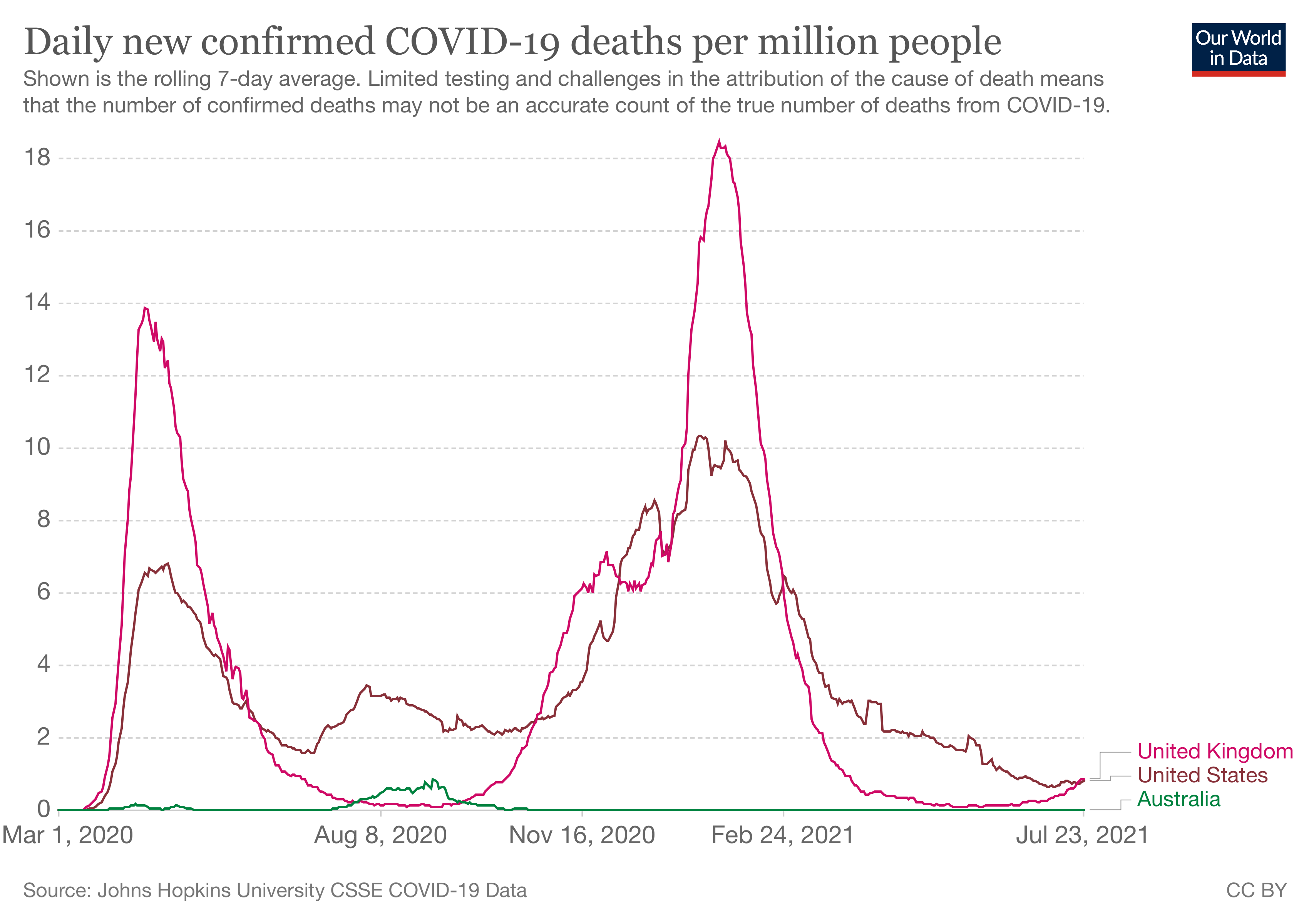
Finally, the numbers of deaths:

The increase in new cases in the UK and US winter of 2020/21 also resulted in an increase in deaths. But the increase in the current northern hemisphere summer has resulted in no increase in US deaths and a marginal increase in UK deaths. What changed? Delta. Virtually 100% of the current new cases is Delta. Last northern winter, virtually none of the new cases were Delta. Delta is more transmissible (apparently) but dramatically less deadly.

Meanwhile, Australia locks everyone up.