Why Government #economic policy is all wrong

The typical thinking in Governments and central banks when it comes to current monetary and fiscal policy can be summarized as:

  • fiscal deficit spending is needed to avoid recession, and kickstart investment, growth and economic activity;
  • lower interest rates are needed to stimulate borrowing and spending by consumers;
  • economies need inflation; persistent low inflation or even deflation is to be avoided.

That this groupthink continues to dominate even after years of practical experience to the contrary, is amazing in itself. More seriously, it is very damaging for our economies and will make economic recovery and future growth delayed and harder. Continue reading


There’s a pattern here

Is it just me? Or have others noticed it, too? The number of articles written about climate change and published in the trade magazines and professional journals follow a common language and structure. Almost invariably, the articles will begin along the following lines: “The risks of climate change are becoming increasingly well-known.” Then, there will usually be reference to some global body, such as the UN, the World Economic Forum, the World Bank and of-course the IPCC. This part of the article could say: “[insert name of global body] believes that the world’s climate is at a tipping point and any further delays in action risk catastrophic damage to the planet.” Then, there is reference made to global commitment to action, taken from the most recent gabfest: “Fortunately, real agreement and commitment to action to halt the extent of global warming and transition away from a carbon-based economy is emerging. Leaders at the [name of summit] signed on to a new set of carbon-reduction targets by 20[xx].” Continue reading

Productivity commission insights (#1)

The draft report of the Productivity Commission titled “How to assess the competitiveness and efficiency of the superannuation system” runs to over 300 pages. Note, this is not the results of an assessment, just how to make an assessment. I wonder how many pages the actual assessment report will have.

However, regardless of its size, I’m not sure how valuable the assessment report will be. Consider this little nugget from page 6: “Product proliferation, high advertising expenditure, competition on irrelevant non-price (non-fee) aspects and high search costs are potentially signs of unhealthy competition.” There you have it – a prejudiced view on what the bureaucracy thinks constitutes unhealthy competition, even before the review starts. And who knew that competition could be divided into “healthy” and “unhealthy”?

What does that statement reveal about the attitude of the assessor?

#Bitcoin. Is it money?

A court in the State of Florida, US, has recently issued a judgement in relation to a money laundering case. The money laundering aspects are not relevant to this post – instead, what is interesting is how the judge viewed bitcoin.

Bitcoin is relevant to the case since that is how the allegedly fraudulent transactions were being conducted. The full judgement is available here http://www.miamiherald.com/latest-news/article91701087.ece/BINARY/Read%20the%20ruling%20(.PDF)

The judge ruled that bitcoin is not money, and hence any prohibitions on money transactions, such as might include money laundering, could not apply to bitcoin. The judge said that while bitcoin had some attributes in common with what we commonly refer to as money, it differs in “many important aspects.” Continue reading

Financial markets context

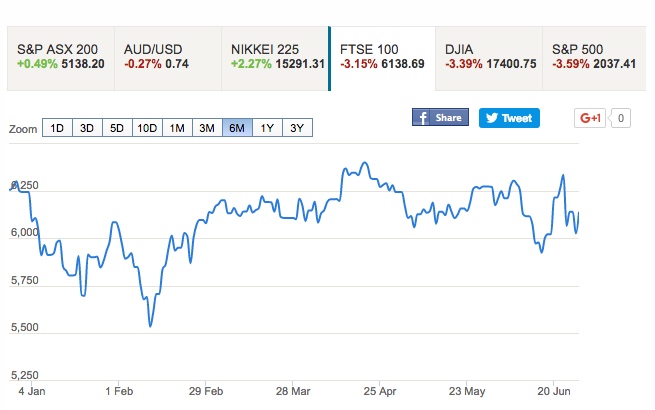
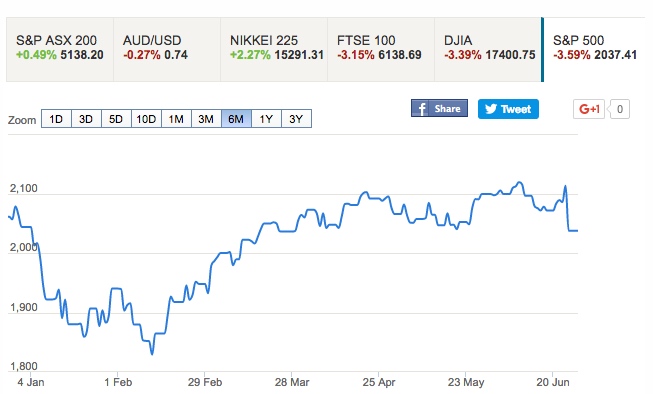
The volatility from #Brexit continues on financial markets. But it is worth placing that volatility in context.

This chart (source: Google Finance) shows the British pound against the US dollar over the last 6 months. The pound has dropped dramatically in the last few days. Although, the level it was at immediately prior to the Brexit vote was the highest it had been in the prior six months.

GBPvUSD

This next chart (source: News Limited) shows the UK equity index, the FTSE 100, again over the last six months.FTSE100_6months

Then the US equity index the S&P500 is in this chart (source: News Limited)

SP5006months

Volatile, yes. Markets always are.

Brexit – get on with it

With the British referendum on withdrawal from the European Union now complete and the issue has been settled in favour of leaving, it is vital that the Government moves quickly to avoid any perception of a political crisis. There could be continuing unpleasantness given that the whole debate became emotional and base. Prime Minister Cameron obviously had to resign. He has stated that his resignation will be effective no later than October 2016. I think he should go sooner. The same applies to the Chancellor of the Exchequer. It is not possible for either of them to continue in their current offices.

Continue reading

Death duties

Ordinarily, I would expect that a Government decision to introduce taxes on the proceeds of a superannuation fund payment to the dependants of a recently deceased person, would be considered a type of death duty. The imposition of that tax would then be considered the imposition of death duties. Call me old-fashioned.

Our current Government, in its budget night announced proposals, introduced death duties. Continue reading