SS America

She was launched in 1940 as the SS America. At the time, she was the world’s fastest ocean liner.
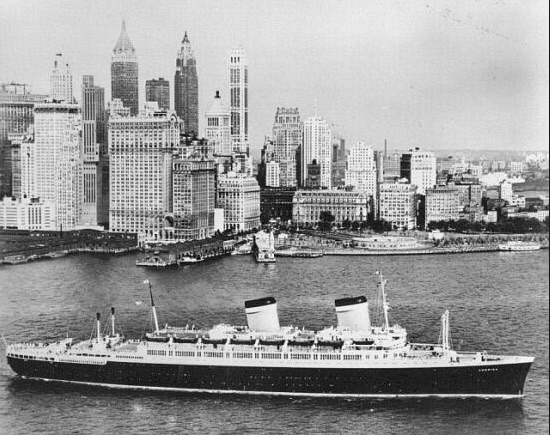
NY

But the second world war had broken out. By December 1941, the US joined the war effort explicitly as a result of the Japanese bombing of Pearl Harbour in Hawaii. The SS America was converted to a troop carrier.

After the war, she returned to the Atlantic route, with  speed; and society; and glamour.
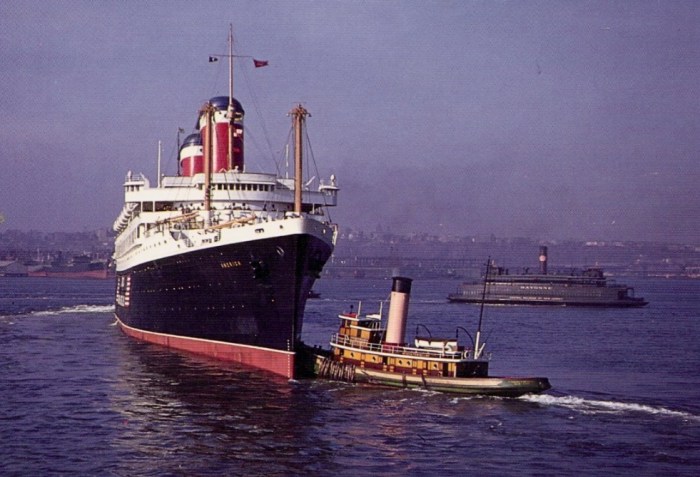
atlantic

In 1964, she was sold to a Greek shipping company and spent the next 15 years circling the world: England to Australia and back to England. This was an emigrant’s route, not a cruise route. If the Suez Canal was open the route was Southampton, Crete, Port Said, Djibouti, Fremantle, Melbourne, Sydney on the way out.  Then Auckland, Panama, Florida Keys, Southampton on the return. Under the ownership of the Greek shipper Chandris Lines, the ship was renamed the SS Australis.

Here she is at Crete, February 1976. I was on that southern outbound trip. Crete was the first stop out of Southampton.

crete

Eventually, she would arrive at Station Pier, Melbourne.

sp

Before the final outward bound stopover in Sydney.

syd

The emigration route came to a natural end in the late 1970s. By this time, the ship was 40 years old. She deteriorated under various subsequent owners. Plans amounted to nothing. She had spent years at dock in Italy before being sold again to a venture that was to turn her into a floating hotel in Thailand. She never made it.

SS America was to be towed from Italy to Thailand, via the Atlantic in 1993. A storm off the Canary Islands intervened.

nearing the end

And there she remained.

final

Travel Tip: Professionals enjoying cruise voyages can remotely stay connected to their cloud hosted virtual workstations having windows applications & Office 365 from CloudDesktopOnline.com. Visit www.Apps4Rent.com

Peak-retirement

Retirement strategies. Saving for and spending during. The world is awash with writings on how to save and invest for retirement. The volume of material is vast and it is being added to daily, including by me. Why is it so? If ever there were a topic that should have been settled over 100 years ago, retirement savings is it. There is no need for continuously adding to the material. The fact that such material is ever growing hints that there is a problem. If the topic was settled, there would be no need for a constant barrage of new material.

There most definitely is a problem in retirement savings (in advanced economies): it is the futility of trying to save effectively on an individual basis without any risk sharing arrangements in the context of lengthening life-spans, higher costs of living and higher expectations of lifestyle. It is a cruel hoax foisted on the bulk of the population that insists they can do it, provided they have the right investment strategy, the right draw-down strategy, the right contribution strategy and so on. But the right combination does not exist. That is why people are always looking for new ways, new ideas, some development or technique that will allow them to save effectively and retire securely in a lifestyle that meets their expectations. Yet it cannot happen but for the small proportion of each country’s most wealthy. Continue reading

Diversity and inclusion – how to kill the concept

It is quite puzzling.

Look at this piece:

Yassmin


An assertion, without any proof or suggestion of how it may be proved, that the oil well cap blew off the well at the bottom of the Mexican Gulf because of a lack of diversity and inclusion in the executive ranks of the oil industry seems an odd way to promote D&I. What is much more likely is that such a statement will be ridiculed publicly and the concept of D&I will be damaged, probably irreparably.


Turnbull achieves what Chifley could not

The Australian retail banks have effectively been nationalised. What Ben Chifley tried to do in 1947 but failed has been achieved in 2017. Chifley was a Labor PM. Turnbull is nominally Liberal.

The banks all operate with a government guarantee on deposits. In effect, the Government, ie the taxpayer, has assumed a fundamental risk of the banking business. They operate within a big 4 policy framework that shuts down the possibility of mergers and restricts competition from other parties. The Government is now going to impose an arbitrary tax on the banks outside normal company tax rules. The Government is going to regulate bank executives behaviour, keep a register of ‘acceptable’ vs ‘non-acceptable’ bank staff, control bankers’ pay and the gender make-up of the employees. There are very few aspects of banking business that are not under covert or overt Government control.

This is the path to socialism.

The end of conservative government in Australia

I am not a particular fan of the big Australian banks – they enjoy privileges granted by Government policy that makes the business of big banking too sheltered from competition, too easy to extract economic rents and protected by barriers that prevent new entrants to that sector. Yet in the wake of the Federal budget for 2017-18 announced last week, I find myself on the same side of the fence as the bankers. The proposed bank tax is disturbing. Continue reading