In its most recent report into coal (prices, supply and demand), the International Energy Agency presents plenty of data to depress a greenie. Or a certain teenage Swede.
In short, prices are up, demand is up and supply is reorganising as China and Russia disrupt supply chains.
I am one of the strongest advocates of free markets among people that I know. When I hear of the left, the cronies, the globalists and the common or garden rent seeker claiming the need for state coercive intervention owing to ‘market failure’, my response is invariably “there is no such thing as market failure, but there are outcomes that you don’t like: don’t get those two confused.”
Really?
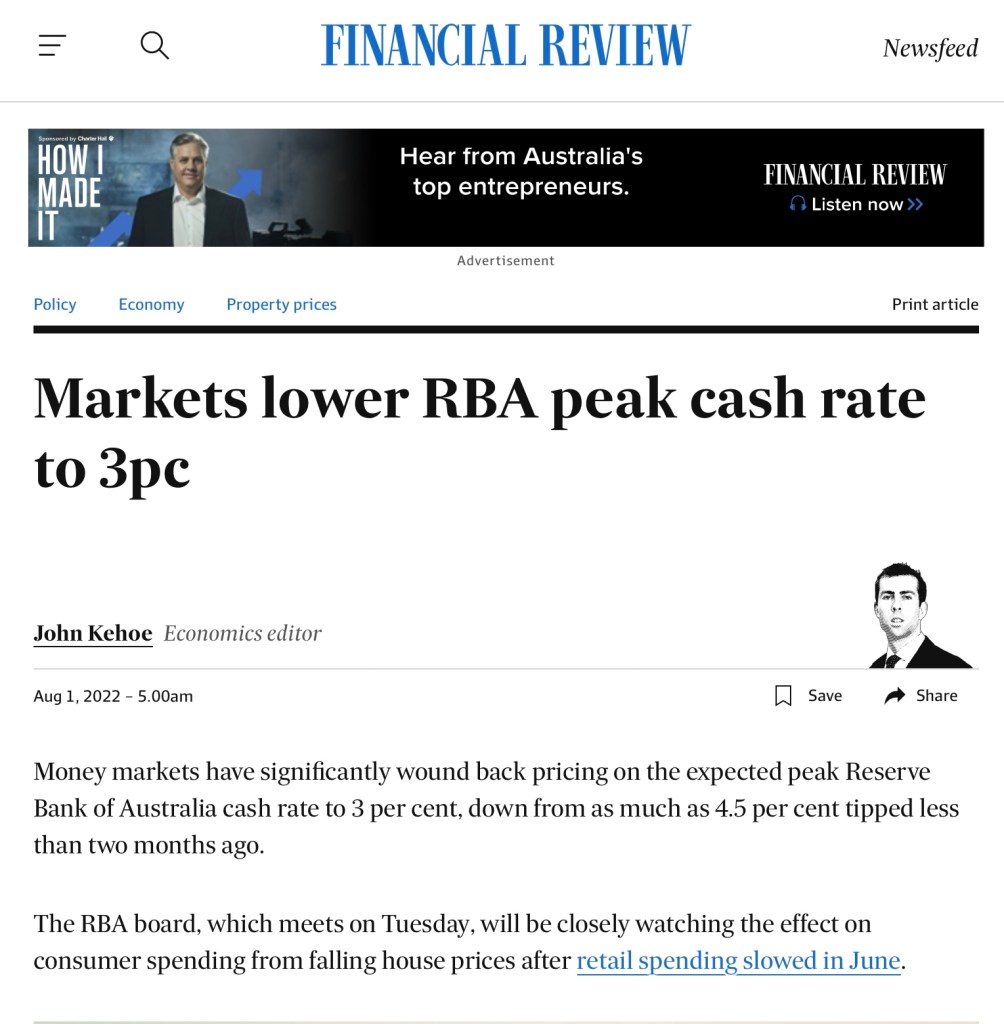
In this case, without proclaiming the market is wrong, I can’t see how it can be right. Ordinarily, higher interest rates will not curb inflation until the real interest rate is positive. So, we’ll see if Mr Market is merely sorting cards on the table and still making up his mind.
It’s sometimes refreshing to get a laugh out of the business press, especially when much news is rather gloomy.
First up today is James Glynn (writing in the Australian) who attempts to defend the Reserve Bank of Australia. His headline says it is unfair to rage against the RBA. Long time readers of this blog will know that I have been a harsh critic of the RBA for many years, so I naturally expected this piece to start my day on a humorous note. James did not disappoint.
Many people working in large corporations feel the same frustration as does Dr Jordan Peterson, well expressed in this monologue “Message to CEOs”. Corporate wokeism has been getting worse for a number of years and business leaders have been broadly weak and fearful in its face. Instead of pushing out the nonsense because it is damaging to customers and staff and therefore shareholders, they have en masse waved it through.
I am perhaps a little more optimistic than Dr Peterson is. I suspect that with hard economic times unfolding, corporate wokeism will become subserviant to corporate survival. The big business bottom line has been relatively easy to keep black for the last 10 years. But from here, red ink may be needed with increasing frequency. CEOs faced with the choice of being turfed out of their contract for missing financial targets vs giving more succour to diversity, equity and inclusion maniacs will see things more clearly. Ask yourself why wokeism has not infected small business. It’s because small business must focus on survival at all times.
Way back in June 2020 when Guy Debelle was still employed by Australia’s Reserve Bank (RBA), he made a speech in response to market jitters over the unprecedented expansion of bank credit. He said it would not lead to inflation.
In November 2021, the RBA Governor Lowe said he wasn’t expecting inflation to hit the 2% to 3% pa target range until late 2023 and so there would be no interest rate increases in 2022 but maybe there would be in 2023.
Woke won’t survive economic rationalism. That is, reality. When push comes to shove, woke will be shoved aside as keeping the heating on will be paramount. Sooner the better.
Oh dear. The Australian Energy Market Operator has suspended the market. The Operator says the market was “impossible to operate”. Does this constitute a market failure? It’s definitely a failure of something.
______________________________________________
I say it’s not a market failure. That’s because it’s not a real market. The authoritarian left often decries market failure as reason for Government intervention in all manner of ways. Well, here’s an example of a highly restricted and distorted pseudo market failure right in front of our eyes at a time when the energy supply is tottering on the verge of blackouts.
The reason for this failure is precisely due to years of Government intervention, mismanagement and lies. Goodness knows what happens from here, but mark June 2022 as the month in which the creaking facade masquerading as an energy system in Australia crumbled.
Update from 17 June, 5:30 pm AEST: coal and gas are currently producing 78% of Australia’s electricity supply.
We need more renewables, obviously. Look at the contribution to Australia’s energy supply over the last 48 hours. After decades of subsidies to promote windmills, solar panels, hydro schemes and biofuels, the total output of renewable sources is woefully tiny. Not enough subsidies, I expect.
Price inflation data for May 2022 was released yesterday in the US. Over the full year to end May, the consumer price index increased by 8.6%. The AFR reports that this is the highest 1 year increase in 40 years. The stock markets reacted badly. The Dow Jones industrial average lost 2.7% and the NASDAQ lost 3.5% in value.
That stocks have been broadly overvalued is well accepted. Part of the reason supporting high valuations was low discount rates. A year ago, the average P/E ratio on stocks in the S&P500 was over 37. Today, it is 21.5. That reduction will have been largely driven by recent market sell offs and revaluations with higher discount rates as yields on debt markets increase. But 21 still looks expensive. I’m not sure I want to pay $21 to buy a future earnings stream of $1pa. With the high likelihood of further increases in discount rates plus risks to underlying earnings owing to economic malaise, the P/E ratios are under pressure both on the top line and bottom line.


 Australian Actuary