Oil prices – an economics lesson with potentially serious outcomes

The fall in oil prices over the last six months has been extraordinary. West Texas Intermediate crude oil, a generally accepted benchmark price,  was trading around US$100 per barrel for the last 5 years, with some volatility, but from August 2014 has appeared to be in free-fall. The price is now just above US$50. Is this excessive volatility ahead of a return to price levels of around US$100 or is it a new normal pricing level? Will it fall further? How will the suppliers react? What happens to the oil price in 2015 is vitally important to the world’s political power plays. In certain scenarios, the potential outcomes are serious.

The immediate effects of the fall in prices are noticeable at the petrol station. It costs quite a bit less to fill the car’s tank when street prices (in Melbourne) have fallen from about 150 cents per litre to 115 cents. Those of us driving V8 engined cars are very happy about that. (Those in their green hybrids are metaphorically fuming, but that is another story.) Cheaper energy prices benefit consumers – heating, cooling, cooking, transport etc all become more affordable. While this allows people relatively rich western societies to spend more on non-essentials, for the poorer societies, it can bring people out of poverty and subsistence living.

For economies that generate national income from the sale of oil, such as the OPEC members, Russia, Nigeria and others, the price fall results in a serious hit to revenues. Oil producers, and the many elements of an economy that service those producers, are going through a very substantial enforced reorganisation to avoid collapse. Nationally, this results in reduced state revenue from falling tax revenues, duties, royalties etc. The adjustment in the labour sector as workers are laid off creates increased pressure for Government assistance payments and other spending pressures. For an economy that is heavily dependent on oil revenue, the benefits of cheaper prices will not be enough to offset the pain of such a hit to GDP.

There has been chatter about the reasons behind the price fall. One of the most bizarre comes from the President of Iran who believes that there is a conspiracy against Islamic countries in the middle east. He fails to nominate who is behind the conspiracy and how it is being effected. Others, such as the President of Russia, believe Russia is the target of pay-back for its meddling in Ukraine. This shows the political pressure those leaders are feeling right now. More convincing are the arguments that point to a shift in the oil supply curve. Continue reading
The shape of mortality, updated

The Australian Government Actuary has released updated life tables of the Australian population based on the 2011 census. The media release is available at http://www.aga.gov.au/publications/life_table_2010-12/media_release.asp

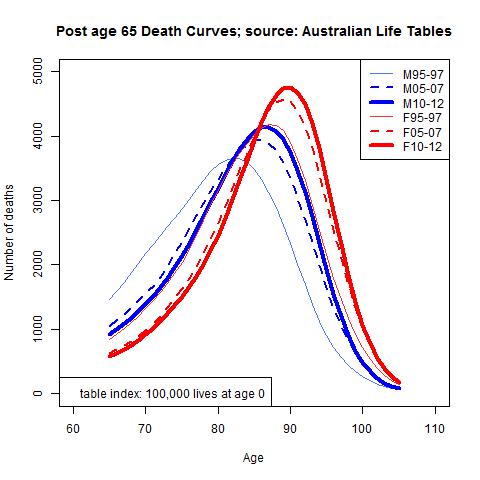
Continuing on a theme, I have updated my chart that shows the shape of mortality at older ages. The chart now shows the number of deaths at each age from 65, based on a standardized starting population of 100,000 at birth, over a 20 year period. The data is split for males and females.

There are some interesting conclusions to draw. Firstly, life expectancy continues to increase for both males and females but the improvements between 1995 and 2010 were more significant at older ages, ie from mid 80s and above. This is suggesting an increasing skew in the curve, with more people living to higher ages but then dying in greater numbers at those advanced ages. Secondly, the curve for men in 2010 now approximately matches the curve for women that existed based on 1995 data.

result

As always, while this has implications for retirement income planning at the policy level, it has less direct applicability at the individual level. Yes, it is true that life spans, on average, are increasing. But people don’t live according to averages.

Wrong way – go back

Most Australian freeway exit ramps have a sign directed at drivers who enter the exit ramp by mistake into the oncoming high speed traffic – “Wrong way – go back”. It’s not a bad warning. It is written in very large white text on a red background. Hard to miss, I suspect, even for the myopic drivers among us who presumably make this mistake from time to time.

I’d like to take those “Wrong way – go back” signs and use them in other parts of Australian life. In particular, the community needs to be warned that the suffocating policies of Governments, mostly of the left-of-centre type, to get involved in virtually every aspect of our lives right down to the most mundane, represents the wrong way. I don’t claim credit for the originality of the saying but it rings true – the left (or liberals in the US sense) have switched their efforts – they are no longer attempting to nationalise industries but instead are full steam ahead at nationalising the family.

Continue reading

Sicilian actuaries and the force of mortality

According to the old joke, while actuaries are able to tell you the number of people expected to die each year, Sicilian actuaries can tell you not only the number of people, but also their names and addresses. Last week I put up the shape of death curves in the ages after 65, according to Australian population studies. At roughly the same time, Mercer released a report indicating that it was the white collar workers who tended to live the longest. Continue reading

The shape of death, retirement incomes policy and property rights

result

The shape of death matters to policy makers, not so much to the individual. This image shows the number of expected deaths from age 65, based on a normalised starting group of 100,000 lives at birth.  The underlying data has been extracted from the Australian Life Tables, published by the Government Actuary. Two tables are plotted here, based on studies in 1995-97 and 2005-07. Continue reading

Federal Court judge interference in the Australian labour market

Mordecai (Mordy) Bromberg is a judge in the Federal Court of Australia. Several days ago, he ruled that a car manufacturing company in Australia was not permitted to put an industrial matter to its employees for a vote. The issue was over a planned amendment to the workplace agreement that is currently in place. The company’s stated intention was to reduce costs in the business to improve productivity. Reading between the lines in the context of car manufacturing in Australia, it is also likely that the future of the business is under question. 

Instead of allowing employees to vote on the matter, the judge ruled no vote was permissible.

In a free and productive society, employers and employees voting on matters that concern them is surely a sign of common sense, maturity and respect for freedom. In the event that a judge deems such behaviour should be prevented, then some other force is at work. It is not a force to be welcomed if living standards are to be maintained.


The role of the consumer in driving down wages

The Australian Government’s curious attack on the 457 visa migration programme has spawned associated chatter on talk-back radio. One theme that reappears is that 457 visa workers are willing to work for less pay and employment conditions. This argument goes on to purport that there are plenty of Australian workers qualified to do the job but who want pay and conditions higher than business will pay because “those Filipino workers are more malleable”, in the words of one prominent ABC Melbourne morning radio show host. So, business is blamed for rorting the system to drive down wages and keep Aussies out of Aussie jobs.

The proponents of these arguments must have regard to the role of consumers in our economic system, and of course, those consumers include the unwitting commentariat themselves. Continue reading

Tax Forum

Last week’s tax forum in Canberra did not actually achieve much, other than general agreement that the tax system could be improved. However, one snippet: the assistant treasurer was reported as saying that the tax applied to superannuation income streams and annuities in particular needs review. This would be a welcome review.